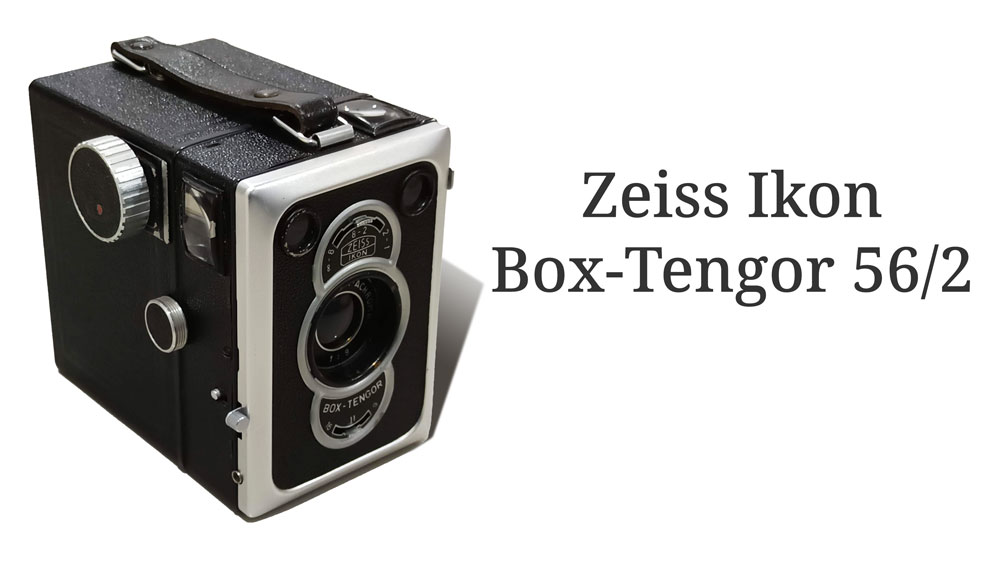
Zeiss Ikon Box Tengor 56/2
“The King of Box Cameras”
When people think of classic box cameras, they often imagine simple point-and-shoot mechanisms with few adjustable settings. However, the Zeiss Ikon Box Tengor 56/2 (the final revised model produced between 1951 and 1956) stands out as a refined, fully featured box camera that was well ahead of its time.
Key Specifications & Features
-
Camera Type: Medium Format Box Camera
-
Film Type: 120 Roll Film producing large 6 × 9 cm negatives (8 exposures per roll)
-
Lens: Goerz Frontar-Achromat 1:9 (100mm)
-
Advantage: Built with a 2-element achromatic glass lens to correct chromatic aberration, delivering sharper, vibrant, and more detailed images compared to standard single-element meniscus lenses.
-
-
Aperture Settings: 3 selectable apertures via the bottom front lever:
-
f/9, f/11, f/16
-
-
Focusing System (Zone Focus): 3-zone distance focusing via the top front lever:
-
1 – 2 meters (Portrait)
-
2 – 8 meters (Group & Street)
-
8 meters – $\infty$ (Infinity) (Landscape)
-
-
Shutter System:
-
Mechanical rotary shutter operating at approx. 1/30 – 1/50 sec (M Mode)
-
Includes T Mode (Time/Bulb) for long exposures in low light or nighttime photography
-
-
Viewfinders: Two bright reflection-type prism viewfinders for horizontal and vertical framing
-
Double Exposure Lock:
-
Features a color indicator flag (Red = Ready to shoot / White = Film needs to be advanced), preventing accidental double exposures
-
-
Connectivity: Built-in threaded socket for a cable release and a PC sync flash contact

Why Collect and Shoot with the Zeiss Ikon Box Tengor 56/2?
-
Zeiss Ikon Build Quality: Crafted with a sturdy metal body, wrapped in quality faux leather, and trimmed with a late Art Deco curved chrome front plate—making it durable, elegant, and highly collectible.
-
Real Exposure Control: Unlike budget box cameras of its era, this camera lets you manually adjust both focus zone and aperture for sharper, more accurate results.
-
Uses Readily Available 120 Film: 120 film remains widely available today. Shooting in the 6x9 medium format renders exceptional depth, rich tones, and fine detail.
Shooting Tips:
-
Because the shutter speed is relatively slow and fixed (around 1/30 to 1/50 sec), use ISO 100 to 400 film for outdoor daylight shooting.
-
For indoor or low-light situations, mount the camera on a tripod (using the tripod socket at the base) and use a cable release in T Mode to prevent camera shake.

-
Title: The Path to Awakening
-
Description: A sweeping perspective down the gallery corridor, showing a long, repeating row of Buddha statues in the Mara-Vijaya posture. The strong leading lines and subtle reflections on the marble floor draw the viewer into a sense of infinite tranquility.
The Box Tengor camera was originally a box camera produced by GOERZ KAMERAS, which later merged with Zeiss Ikon in 1926 and continued to produce the Box Tengor camera under the name Zeiss Ikon Box Tengor 54. It was available in several sizes, the most popular being the 54/2, which used 120 roll film and took pictures of 6x9 cm. The appearance and functions were continually improved from 1938 until production ceased during World War II.

After the war ended, around 1951, production and improvements began. This is the 56/2 model seen here, which is the last model of box cameras. Production ended in 1956. Box Tengor used 120 roll film, took 8 6x9 cm photos. It changed from an all-black box camera to a design trick with a silver border on the front. It used a good quality lens, could adjust the focus distance in 3 levels, adjusted the aperture in 3 ways, and had a slot for flash sync. It could be said that it was the most complete box camera of that era. It was even called the King of Box Cameras.
Let's take a look at the design and functions of this camera.

The camera body is strong and beautiful, covered with black leatherette. It is designed with a silver edge around the camera and has round and curved lines around the lens, as shown in the picture.
On the front, there are two small round windows on the left and right. There are lenses for receiving images to send images to the vertical and horizontal viewfinders. The upper part in the middle is for adjusting the focus distance. The middle round is the camera lens. And the lower part is for adjusting the aperture value.
On the top, there is a leather camera handle and a vertical viewfinder.
On the right side of the camera, there is a film advance dial, a horizontal viewfinder, a rear box lock button, a shutter trigger with a lock button, and at the bottom is a screw hole for the shutter release.
On the left side of the camera, at the top, there is a switch for adjusting the shutter speed mode between T and M. Below that, there is a slot for connecting the flash sync cable.
On the back, at the bottom left, there is a transparent red circle for viewing the number of shots on the back of the film roll. There is a cover to prevent light from entering the film.

Full front view

Two small round windows on the left and right for sending images to the vertical and horizontal viewfinders. There is a shaft for adjusting the focus distance according to the specified numbers, from the right 1-2 meters, the middle 2-8 meters, and the left 8-infinity and there is a Zeiss Ikon logo.

GOERZ FRONTAR-ACHROMAT 1:9 fixed lens, 100 mm, fairly good quality.

Below, the camera name BOX-TENGOR and the aperture adjustment axis are printed on it, from right f9, middle f11 and left f16.

On the top of the camera is a camera handle and a vertical viewfinder. On the left is a small rectangle that warns you when the film is ready to be taken.


If the small rectangular box is white, it means a picture has been taken. When the film is advanced to the next picture, it will be red, indicating that it is ready to take another picture.

On the bottom, there is a threaded hole for a tripod plate, 1/4 inch thread.


The left shutter release has a switch to lock the shutter trigger, preventing accidental release of the shutter. Red means caution, the shutter can be released. White means safe, the shutter is locked. Below that is a threaded hole for the shutter release cable.

Up and down slider to adjust shutter release mode
T(Time) is a shooting mode where the shutter is held down, the shutter will remain open and when released, the shutter will close at the desired time.
M is a normal shutter release. Generally, from what I have read, the shutter speed is not very accurate. According to the manual, it should be around 1/30 seconds.


To load film, pull out the camera lock button and the rear case can be removed.


Top film slot for inserting empty film spool to rotate film and take pictures using the film rotation button.

Film slot underneath for new rolls of film


When the film is loaded, pull the film to the empty film spool on top and turn it until you see the word START, then put the back box back in its original place and press the lock button to lock the back box as before.
Turn the film by looking at the red circle on the back until you see the number 1, which means it is ready to take the first picture, and slide the film viewfinder cover to prevent light from entering.
When the picture is taken, the warning box on top will be white, then you must turn the film to the next picture, the box will be red and ready to take more pictures.
Sample photos from the Zeiss Ikon Box Tengor 56/2 camera.

Sample Photo 002
-
Title: Symmetry of Time
-
Description: An architectural shot highlighting a dramatic interplay of light and shadow (chiaroscuro). Sunlight strikes the gallery pillars and twin guardian lions, casting deep shadows on the stone floor and emphasizing the enduring strength of ancient Siamese architecture.
Wat Pho, Bangkok, Thailand
Zeiss Ikon Box Tengor 56/2 : FomaPan 100 : Pyrocat HD

Sample Photo 003
-
Title: Layers of Devotion
-
Description: A wide-angle perspective looking through an architectural doorway toward a grand stupa adorned with mosaic tiles. The rhythmic, layered tiers of the structure, detailed tilework, and stonework are captured with crisp clarity against the open sky.
Wat Pho, Bangkok, Thailand
Zeiss Ikon Box Tengor 56/2 : Kodak T-Max 100 : Pyrocat HD

Sample Photo 004
-
Title: Eternal Serenity
-
Description: A stunning portrait of the main Buddha image seated atop a lavishly gilded pedestal beneath a ceremonial tiered umbrella, surrounded by vintage hanging lanterns. The intricate mural painting in the background combined with gentle lighting creates a profoundly serene and sacred atmosphere.
Wat Pho, Bangkok, Thailand
Zeiss Ikon Box Tengor 56/2 : Kodak T-Max 100 : Pyrocat HD
Photo Review & Technical Analysis
Camera & Lens Performance (Zeiss Ikon Box Tengor 56/2)
-
Sharpness & Detail: For a box camera, the Goerz Frontar-Achromat 1:9 lens performs remarkably well. The zone focusing system proved spot-on, rendering fine details—from the Buddha statues' features to the temple wall murals and decorative tilework—with surprising clarity.
-
Character: The lens delivers the distinct depth expected from a 6x9 medium format negative, with smooth, natural background roll-off. A subtle optical vignetting at the corners naturally draws the viewer’s eye toward the center of the frame.
Film & Developer Combination (Fomapan 100 + Pyrocat HD)
-
Highlight & Shadow Rendering: The stain developer Pyrocat HD fully draws out the capabilities of Fomapan 100. Highlights remain rich in texture without blowing out, while shadow areas retain subtle details in the stonework instead of falling into pitch black.
-
Tonal Gradation & Micro-Contrast: The film grain is fine and pleasing, with an extraordinarily broad mid-tone range. This gives the entire series an authentic, timeless quality—looking as though these photographs were taken by a master photographer decades ago.


Comments powered by CComment