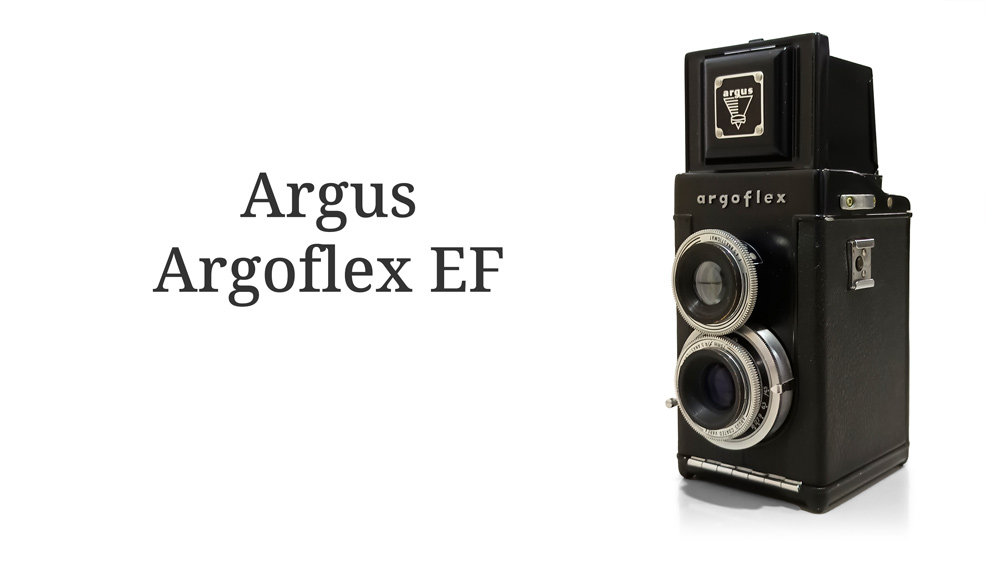
Argus Argoflex EF (Classic Vintage TLR Camera)
The Argus Argoflex EF is a classic Twin-Lens Reflex (TLR) film camera produced by Argus in the United States between 1948 and 1951. As an upgrade to the earlier Model E, the EF model added built-in flash synchronization and refined design elements for a more modern aesthetic.
Key Features & Technical Specifications
-
Camera Type: Twin-Lens Reflex (TLR)
-
Taking Lens: Argus Coated Varex 75mm f/4.5 Anastigmat
-
Viewing Lens: f/4.5 Anastigmat (geared directly to the taking lens for synchronized focusing)
-
Shutter Speeds: T, B, 1/10, 1/25, 1/50, 1/100, and 1/200 sec
-
Aperture Range: f/4.5 to f/18 (adjusted via the lever around the lens rim)
-
Film Format: 620 Film ($6 \times 6$ cm format), explicitly marked inside the chamber as
USE 620 FILM -
Viewfinder: Waist-level finder with a pop-up magnifying glass for precise focusing
-
Body & Construction: Black metal body wrapped in leatherette, featuring a standard tripod socket at the base and a cable release thread
Collector's & User Notes
-
Film Compatibility Today: Since native 620 film is discontinued, modern photographers can easily respool standard 120 film onto original 620 spools to shoot with this camera today.
-
Vintage Charm: A classic piece of American photographic history, the coated Varex lens helps reduce flare while delivering distinct vintage color rendering. It serves as a fantastic display piece for collectors, as well as a functional medium-format camera for vintage street and portrait photography.
It is a twin-lens reflex camera (TLR) produced in the United States in 1948-1951, a period of only 2 years in total. The camera body is made of molded metal, covered with black leatherette, simple and beautiful, which is different from previous models and the next model with the camera body made of Bakelite. This model is developed from the Argus Argoflex E produced before World War II by adding F at the end, meaning there is a hot shoe flash sync attached to the left side of the camera. But it can only be used with flashes produced specifically for that model at that time. It cannot be used with general flashes and flashes used today. The Argus Argoflex EF is a true TLR camera, that is, a pair of lenses, viewing and taking pictures, moving the focus simultaneously by turning the ring on the front lens. There is a gear on the connecting ring. But after this model, Argus only produced cameras that are pseudo-TLRs. The lens has a fixed focus and uses a zone focus system instead. ...
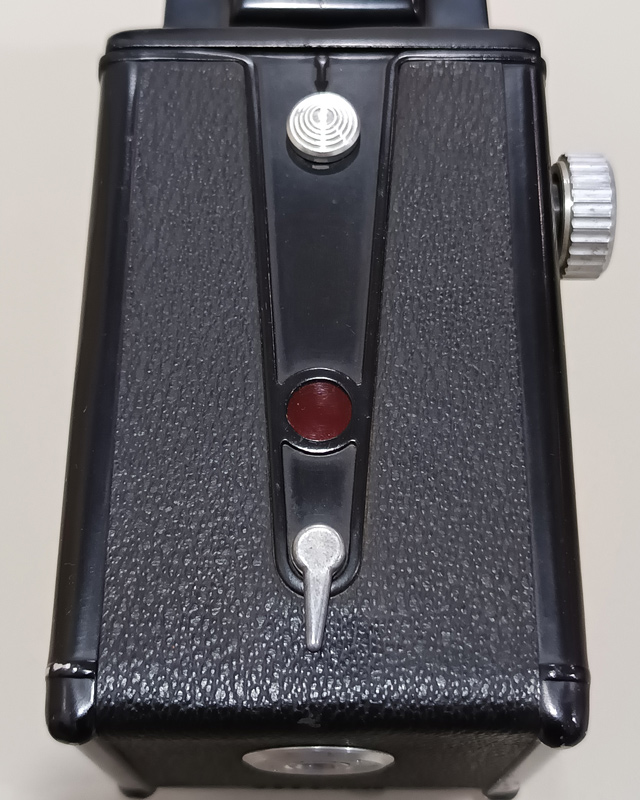
The camera body is smaller than its predecessors. It uses 620 film rolls, which are smaller than 120 film rolls, and cannot be converted to 120 film rolls like previous models. It can take 12 photos measuring 6x6 cm. In terms of camera operation, aside from the film roll dial on the side, all settings are on the front lens. On the back of the camera, there is a transparent red circle with a light-blocking on/off switch for viewing the numbers on the back of the film. On top, there is a cover to open and close the waist-level viewfinder. Under the camera, there is a tripod screw hole.
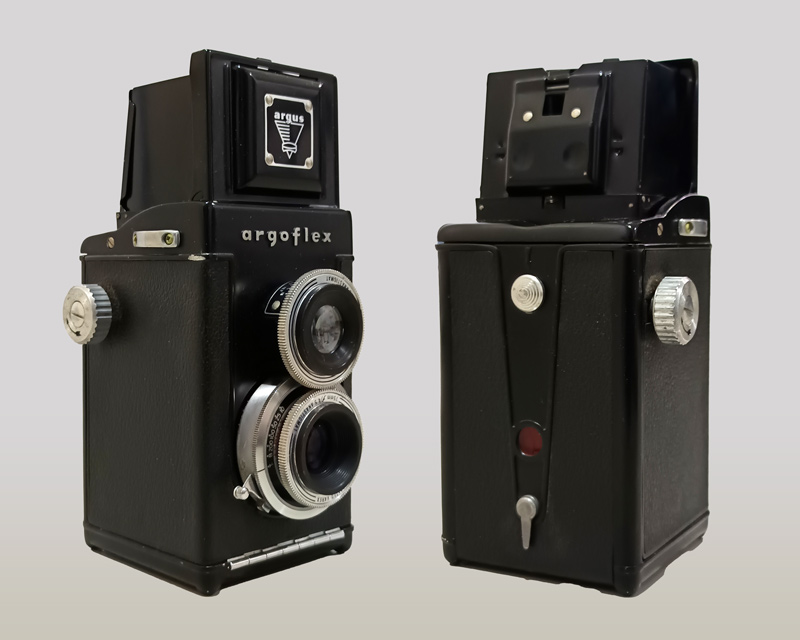
The two 75mm f/4.5 front lenses are coated with three Argus Verx Anastigmat elements, with the rear two fixed to the camera body. The front element moves in and out to focus with the rotation of the front ring, connected by a gear. The Argus Argoflex EF is one of the few cameras that has the same top and bottom lenses. Most twin-lens cameras, in order to cut costs, use the cheaper top viewfinder lens, which is intended for viewing only.
Let's take a look at the details and different parts of using the camera.
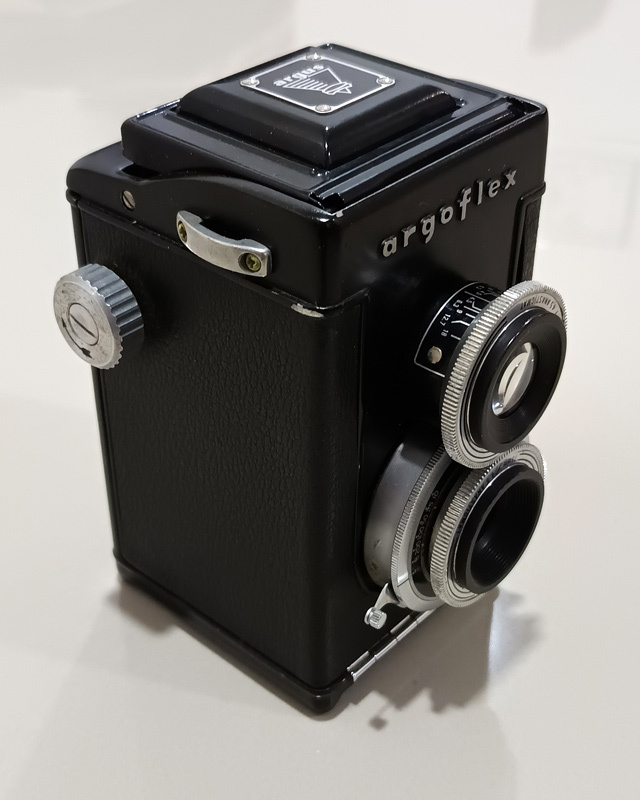
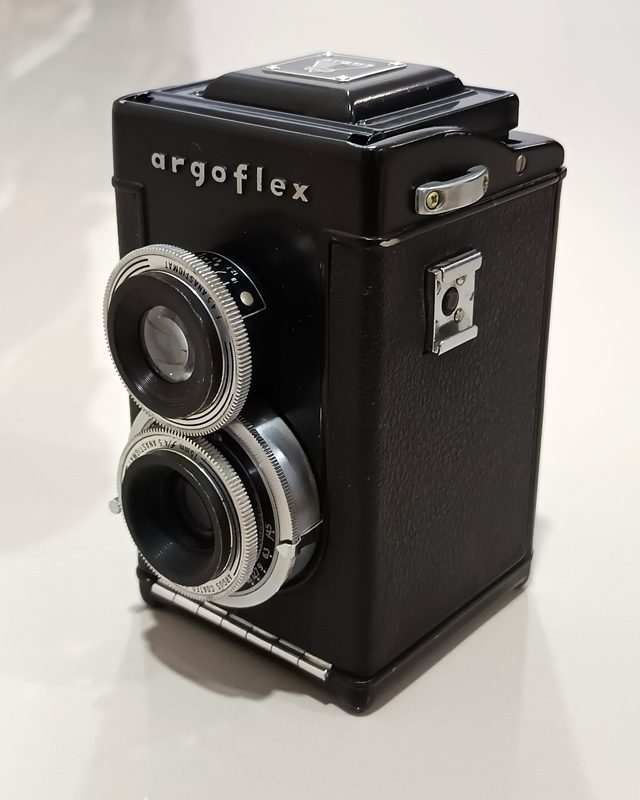
On the camera body, there is a cover, a viewfinder.
On the right side of the camera, there is a strap for a neck strap, a dial for rotating film rolls inside the camera.
On the left side of the camera, there is a strap for a neck strap, a flash mount (made specifically for this model).
On the front, at the top, is the classic argoflex logo, beautifully done. Below that are the dual lenses, the upper one for viewing images, the lower one for taking photos.

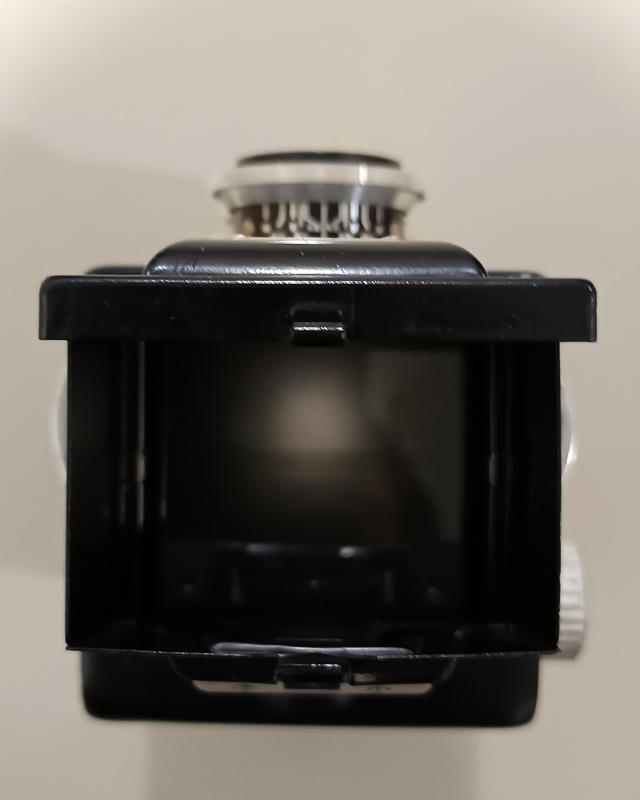
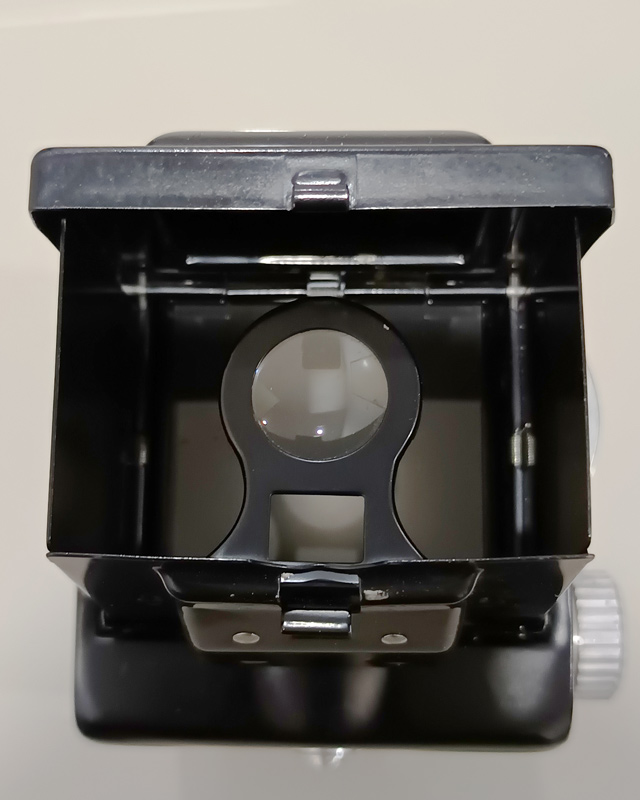
The top cover has a beautiful Argus logo. When opened, you will see a mirror reflecting the image from the top lens set for composing the image. There is a magnifying glass to help with focusing.
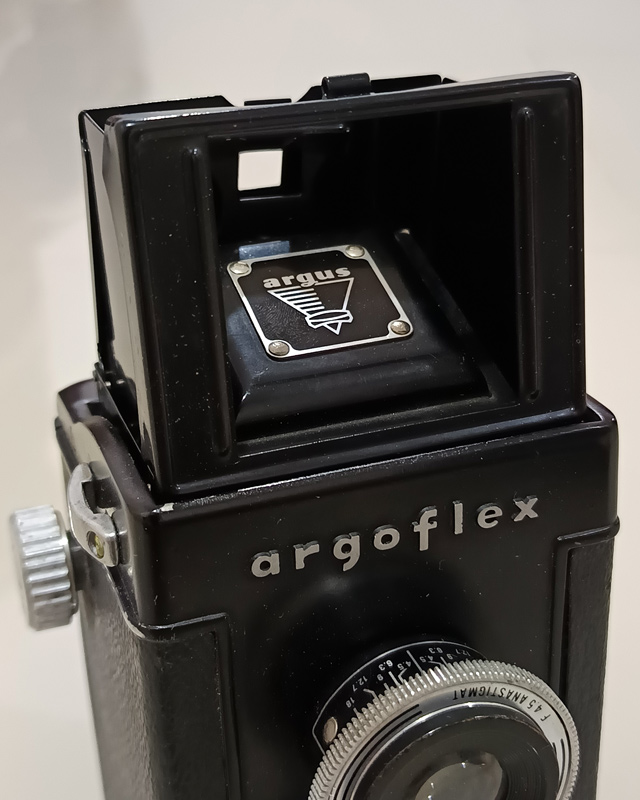
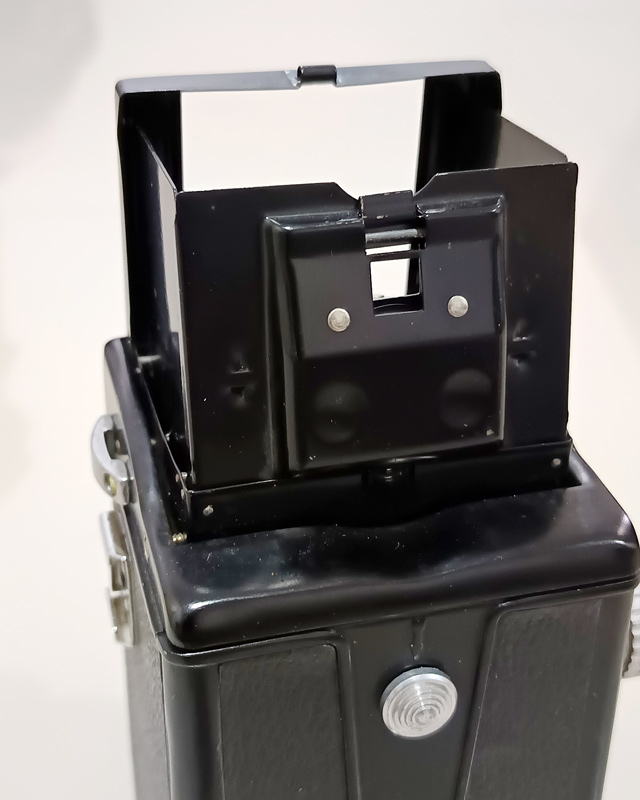
The front of the top cover can be flipped inward to allow eye-level viewfinder use by aiming from the rear square to the front viewfinder.
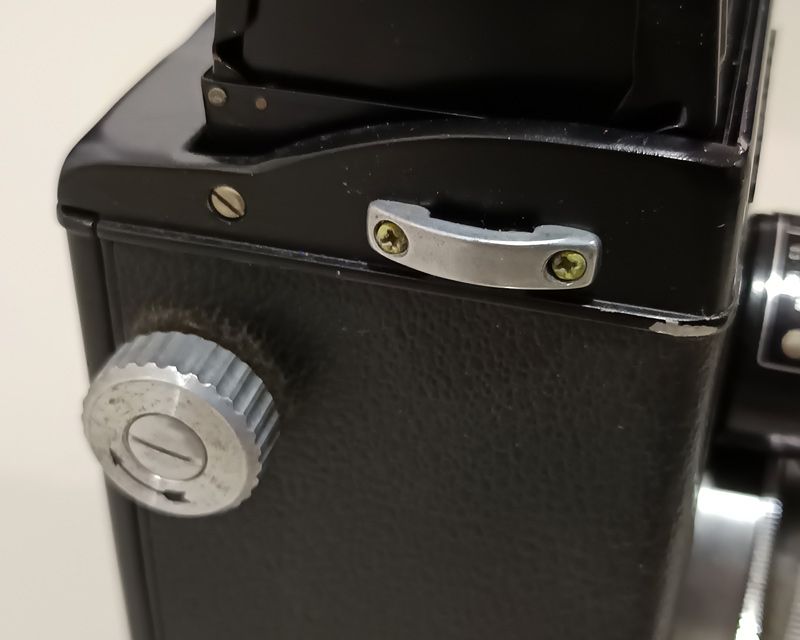
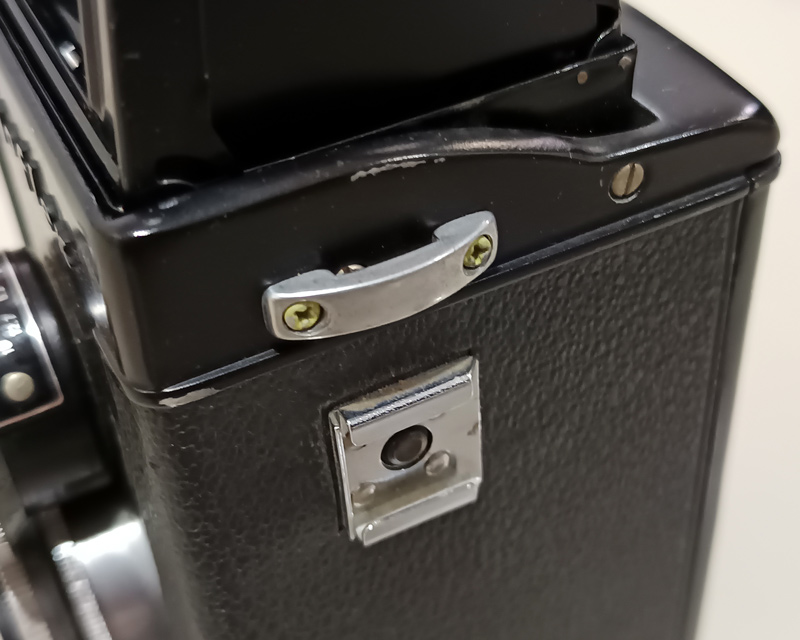
Open the front and back cover.
On the right side of the camera, there is a dial for film advance and a strap for a neck strap.
On the left side of the camera, there is a slot for a flash. It must be a flash that is specifically made for use with this camera. Current flashes cannot be used and there is a strap for a neck strap.
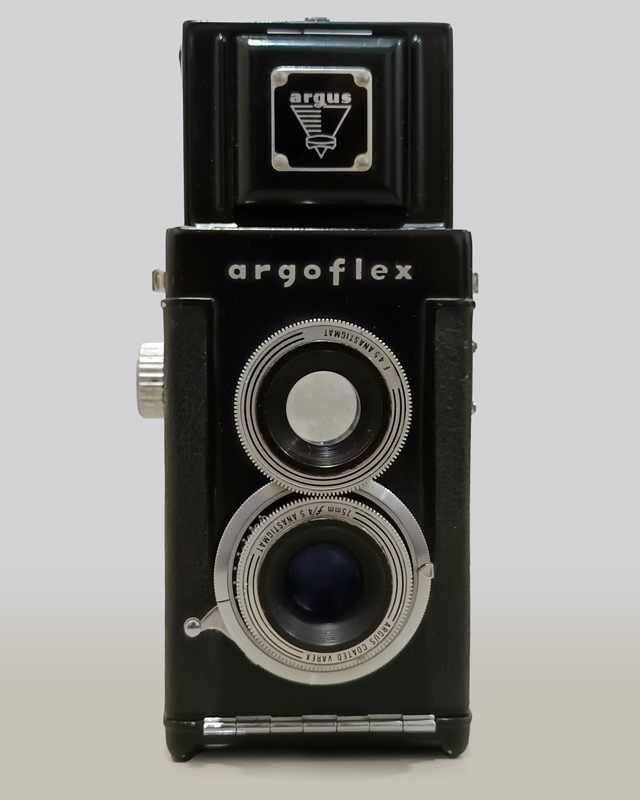
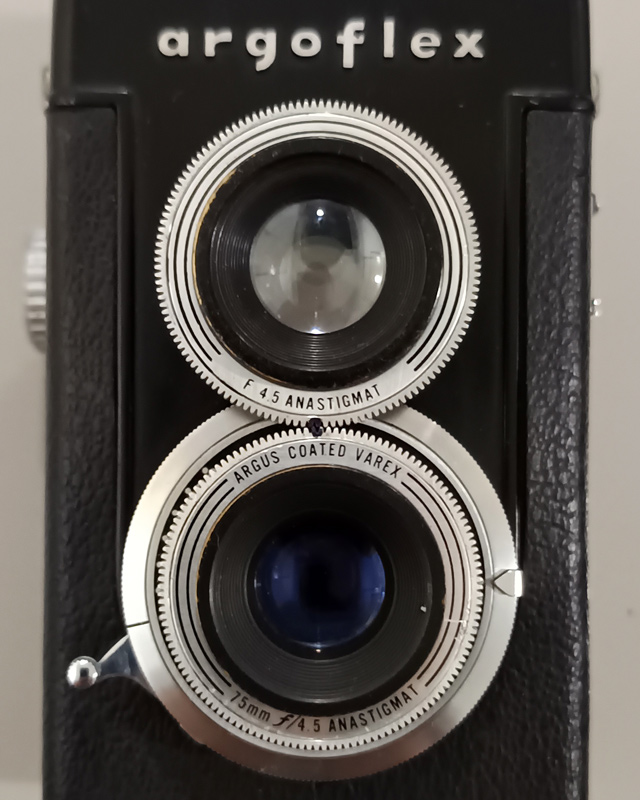
Front view, top cover, argus logo and the camera body has a beautiful Art Deco argoflex logo.
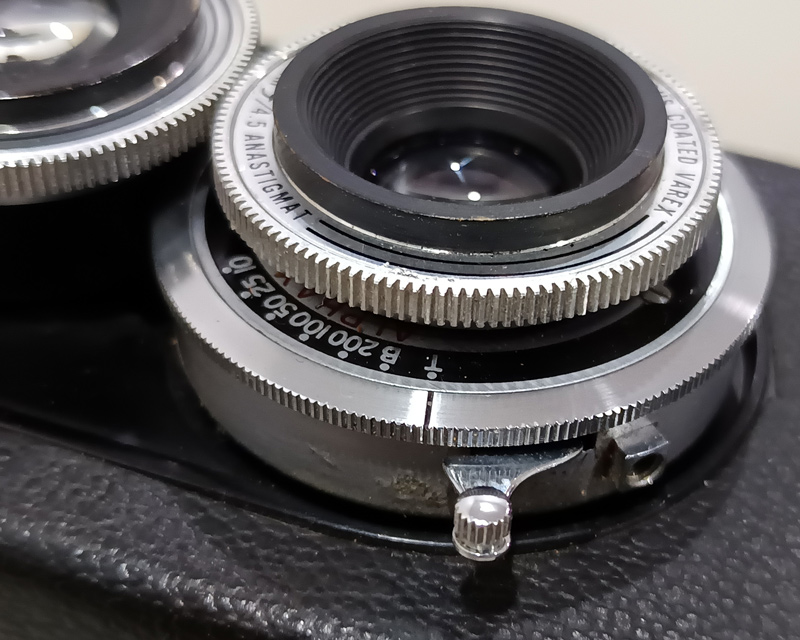
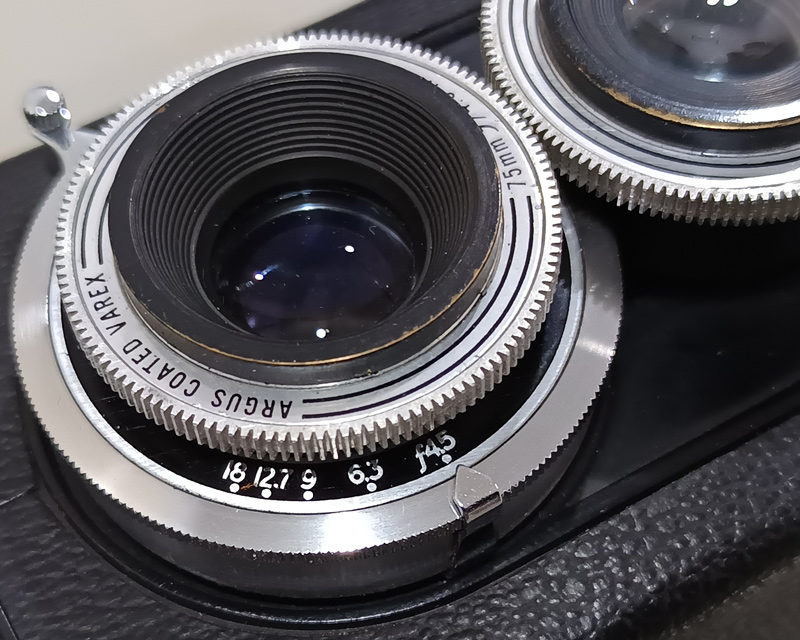
Twin lenses, geared together, are ARGUS COATED VEREX 75mm f/4.5 ANASTIGMAT lenses. When the front ring is rotated, the focus distance is rotated simultaneously.
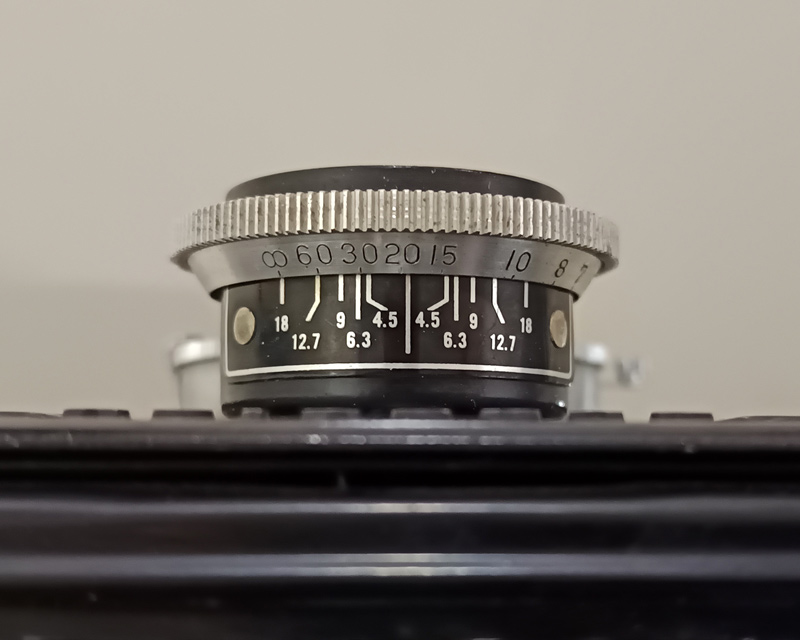
The viewfinder lens set, the top has a scale indicating the focus distance and depth of field.
The right side of the lens, the bottom set, the shutter speed adjustment ring, has a number indicating the shutter speed, a shutter switch, and a screw hole for the shutter release.
The left side of the lens has a lever for adjusting the aperture value and a number indicating the aperture value.
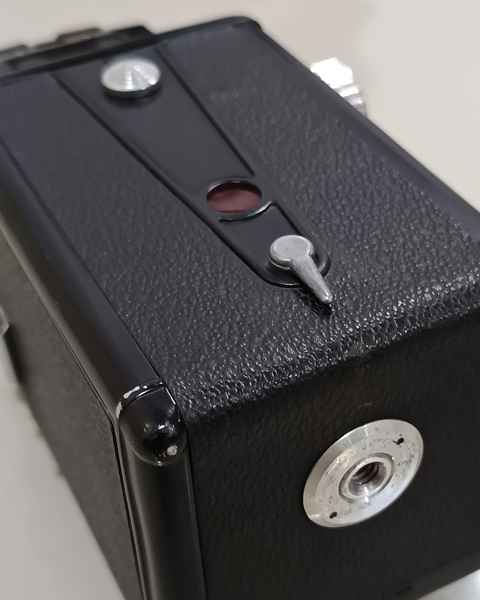
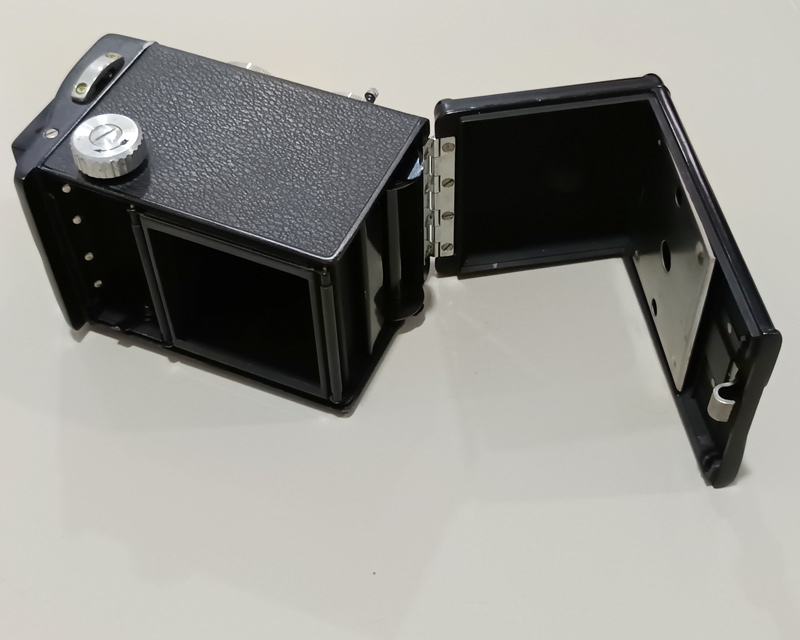
On the back, at the top, there is a button to open the back cover, a transparent red circle to see the numbers behind the film, a button to open and close the window to see the numbers, and below, a screw hole for a stand.
Push the top circle down to open the back cover to insert or remove the film.
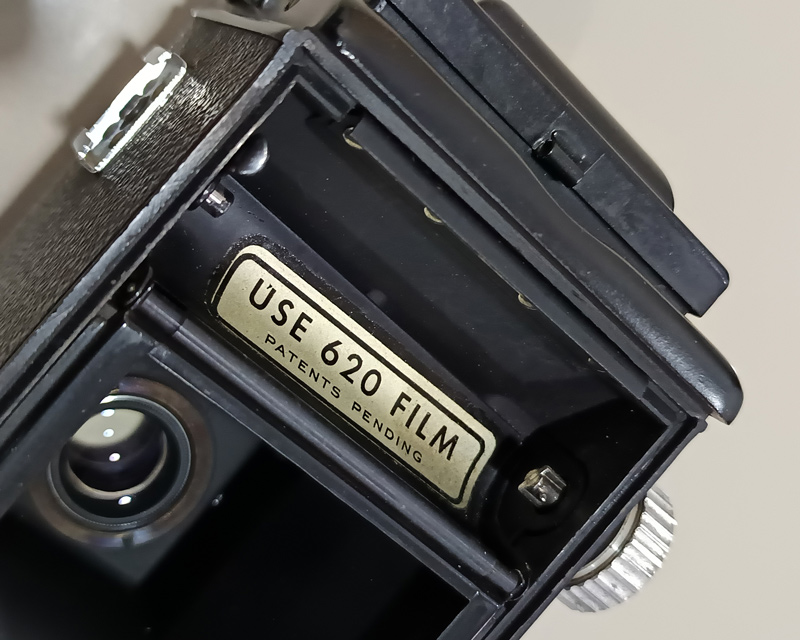
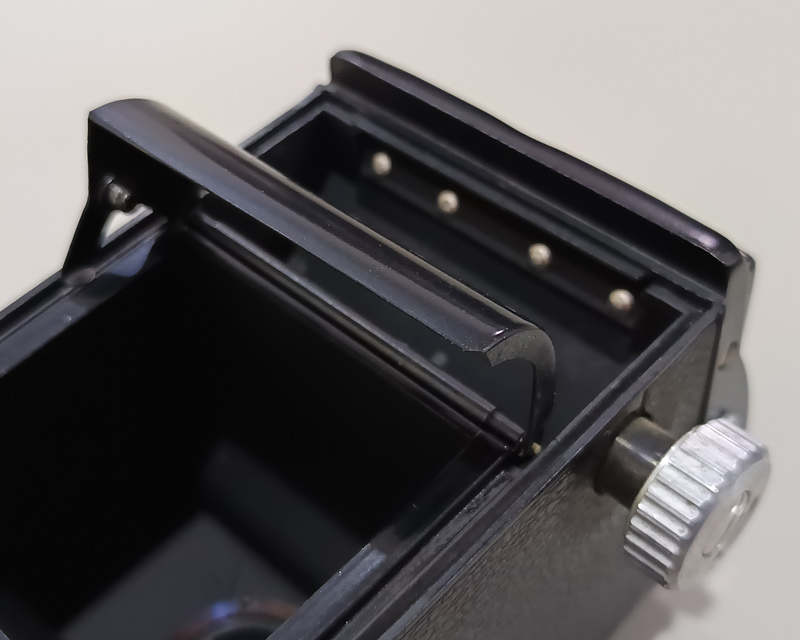
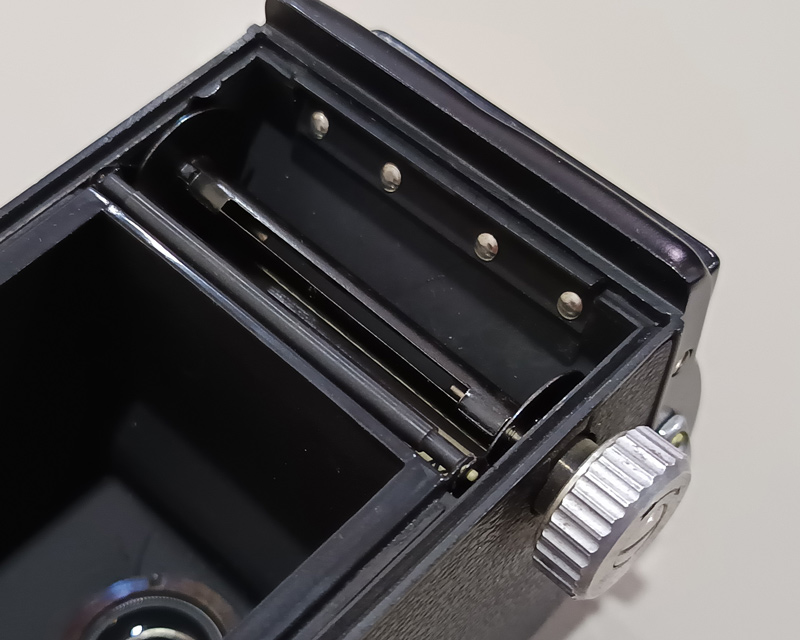
The top film slot has a sticker saying it is for 620 roll film.
Pull out the film roll knob on the side to pull out the slot for the film spool.
Insert the empty film spool and push it back into place. Rotate the film roll knob so that it fits into the film spool so that the film spool can be rotated.
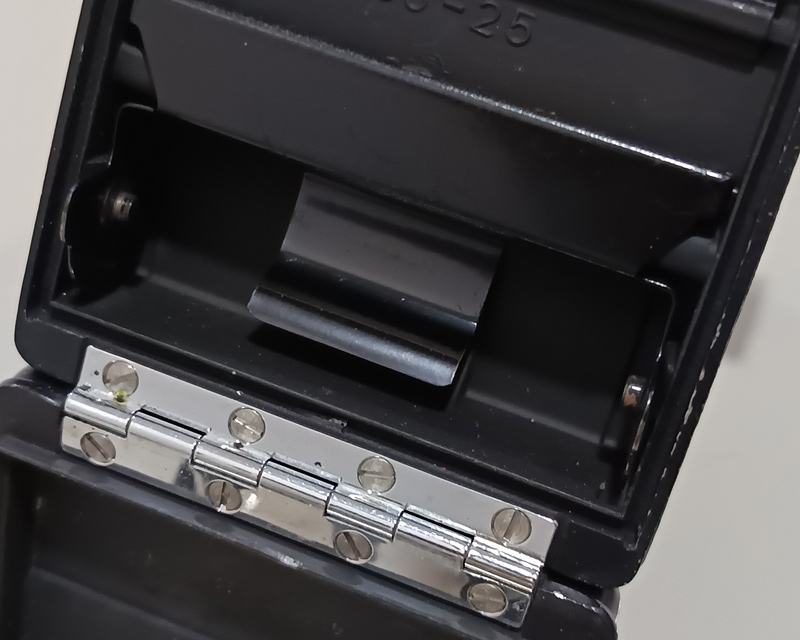
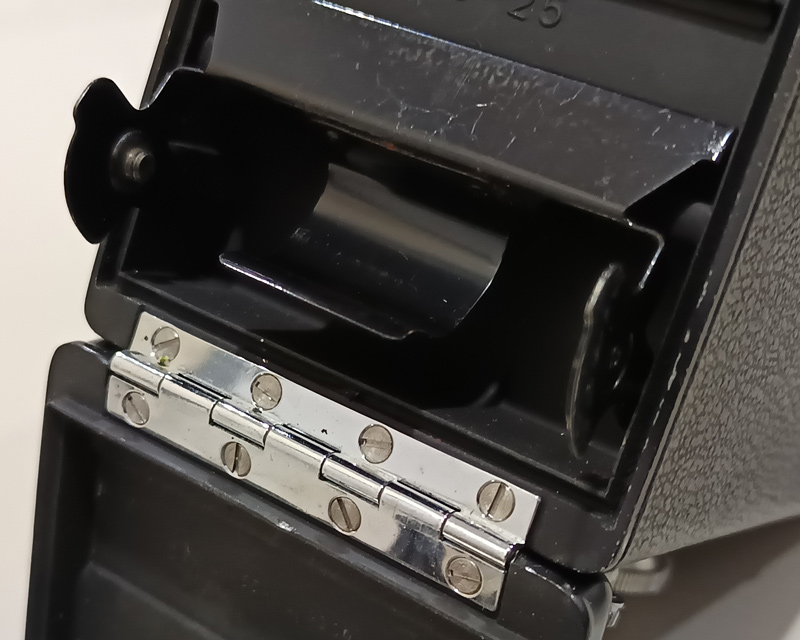
The film slot at the bottom is for inserting a new roll of 620 film that you want to use for taking pictures. Pull out the film slot, insert the film into the axis, and push it back into place.
After loading the film, close the back cover, turn the film until you see the number 1 in the red circle at the back, and it is ready to take pictures.
Sample images from the Argus Argoflex EF camera.

Photo Series: "Reflections of the Past at Wat Pho"
Gear used: Argus Argoflex EF (circa 1948)
Lens: Argus Coated Varex 75mm f/4.5 Anastigmat
Film: Lucky SHD400
Developer: Paradinol 1:100 20c 30:00m
3 November 2024
Argus argoflex EF
Argus Coated Varex Anastigmat 75mm f/4.5
Lucky SHD400 : Paradinol 1:100 20c 30:00m
Epson V600 : Photoshop : Digital Contact Sheet
 Sample Photo 001
"Details of Faith"
Caption: A close-up emphasizing the elaborate stucco and glazed porcelain tile work surrounding the Phra Mondop structure at Wat Pho, set against a simple sky background.
Photo Review: Even in monochrome, the subtle tonal separations produced by the Varex Coated lens allow viewers to appreciate the fine craftsmanship of the mosaic tiles. The contrast between the intricate architectural patterns and the clean sky highlights the subject beautifully. The classic grain of Lucky SHD400 gives this frame the feel of a historical photograph taken decades ago.
 Sample Photo 004
"Perspective Through Time"
Caption: A wide-angle view capturing the elegant Phra Mondop (scripture hall) and the surrounding stupas of Wat Pho, framed naturally by a large tree trunk in the foreground.
Photo Review: This shot brilliantly demonstrates the performance of the Coated Varex lens, delivering sharp details from the foreground tree trunk to the distant spires of the Phra Mondop and stupas. The moderate contrast highlights the architectural depth clearly. Although ISO 400 film inherently introduces some grain, the grain structure here appears smooth and enhances the overall vintage aesthetic.
 Sample Photo 005
"The Gate Guardian"
Caption: A detailed close-up of a Lan Than (Chinese stone warrior figure) standing guard near the side entrance of the Reclining Buddha Viharn, capturing intricate details of its traditional armor and weapon.
Photo Review: A true showcase of the lens's signature character. The texture of the carved stone and clothing folds are captured exceptionally well. Side-lighting from the sun creates dynamic shadows, breathing life into the sculpture. The smooth grayscale transitions—from bright highlights to deep shadows—give the image a classic, powerful presence.
 Sample Photo 012
"The Sang Plaeng Guards"
Caption: A low-angle shot of the "Sang Plaeng" statues (mythological Himmapan creatures) flanking an arched gateway, complemented by carefully arranged bonsai plants.
Photo Review: Extremely well-balanced with great composition. The contours of both Sang Plaeng figures are rendered accurately without noticeable lens distortion. The lens captures fine nuances, such as the bonsai leaves and the shoes neatly removed on the stone pavement. The deep mid-tones give the statues a heavy, grounded, and lifelike quality.
Overall Review for Argus Argoflex EF & This Series:
This photo series proves that vintage cameras like the Argus Argoflex EF are more than capable of producing rich, timeless artwork today. The legendary Varex Coated lens offers balanced contrast—neither too flat nor overly harsh—and renders the intricate textures and architectural details of Wat Pho with surprising clarity. Pairing this classic American TLR with ISO 400 black-and-white film evokes a deep sense of nostalgia, making each shot feel historic and meaningful.


Comments powered by CComment