
Zeiss Ikon Cocarette 519/15
If you are looking for a 1920s folding camera with a fascinating history, exquisite German craftsmanship, and a unique mechanism, the Zeiss Ikon Cocarette 519/15 is a piece of timeless history you should not overlook.
Originally designed and produced by Contessa-Nettel, the Cocarette series transitioned under the Zeiss Ikon umbrella after the major merger in 1926. This makes the model a significant bridge connecting the innovation of Contessa-Nettel with the meticulous engineering of Zeiss Ikon.
Technical Specifications
-
Lens: Carl Zeiss Jena Tessar 1:4.5 f=12 cm (120 mm)
-
Aperture: f/4.5 to f/32 (smoothly adjustable via the bottom ring of the shutter)
-
Shutter Mechanism: Compur
-
Shutter Speeds: T, B, 1, 1/2, 1/5, 1/10, 1/25, 1/50, 1/100, and up to 1/250 sec
-
Focusing System: Distance slider on the bottom rail, calibrated from 2 meters to infinity (∞)
-
Viewfinders: Dual-viewfinder system
-
Brilliant Finder: A waist-level rotating glass prism finder for both portrait and landscape orientation.
-
Wire Frame Sports Finder: A fold-out wire frame with a rear sight for eye-level action shots.
-
-
Country of Origin: Germany
Key Features and Iconic Design
1. Unique "Cocarette" Film Loading Mechanism
The defining characteristic of the Cocarette lineup is its film loading method. Unlike standard vintage folding cameras that require removing the entire back plate, the Cocarette utilizes an internal film tray/spool cage system with a signature circular lock and side key handle. This design ensures tight film tension and excellent light-tightness.
2. The Legendary Carl Zeiss Jena Tessar f/4.5 Lens
Widely renowned as the "Eagle Eye" of photographic optics, the Tessar lens delivers razor-sharp resolution and outstanding contrast. Even when shot wide open at f/4.5, it renders smooth depth, rich dimension, and vintage bokeh signature to early German glass.
3. Solid Body Architecture & Metalwork
-
Built-in Tabletop Stand: The front bed features a fold-out metal stand engraved with the Zeiss Ikon logo, allowing the camera to stand securely on flat surfaces in portrait orientation.
-
Ivory Focusing Scale: An easily readable ivory-colored plate indicating focus distance in meters with smooth lever travel.
-
Leatherette Body Finish: The metal chassis is wrapped in fine-grain leatherette with chrome accents, offering a premium tactile feel.
Collector's Summary
The Zeiss Ikon Cocarette 519/15 is far more than an antique display piece. It is a masterpiece of Golden-Era German mechanical engineering—equally suited for collectors looking for a mint historical artifact and film enthusiasts who want to experience pure, 100% mechanical medium-format photography.

In the 1920s Contessa-Nettel merged with the Zeiss Ikon group. The Cocarette series continued to be produced, as did the many other collapsible cameras that existed. These were medium-quality roll film cameras, bearing the Zeiss mark. From 1926 until 1929, the Cocarette cameras were given the model number '519', with variations such as 519/14, 519/2, 519/15, with the numbers after them indicating the various film sizes used.
Focusing is done using a button located next to the lens on the folding platform. Push it to move the lens unit forward or back. On advanced models, the lens can be moved vertically up and down. All cameras have a Brilliant Viewfinder that rotates horizontally and vertically. Some models have a built-in spirit level and some even have a wireframe viewfinder.
The Zeiss Ikon camera you see here is the 519/15 model. It uses 116 roll film, which is larger and was produced before the 120 roll film we use today. However, because the film was large, the camera had to be large as well, making it inconvenient to carry and use. Its popularity declined. Later, the production of 116 roll film was discontinued, and cameras that used 116 film had to be discontinued by default. ...
I bought this camera because I liked the curved design of the camera body. When I saw it, I wanted it right away without any reason related to its use, quality, or anything else. So I looked for one that wasn't too expensive. I don't know if it's usable or not. It's still good enough to display. So I got this one. Let's take a look at the details and how to turn on the camera for use first.
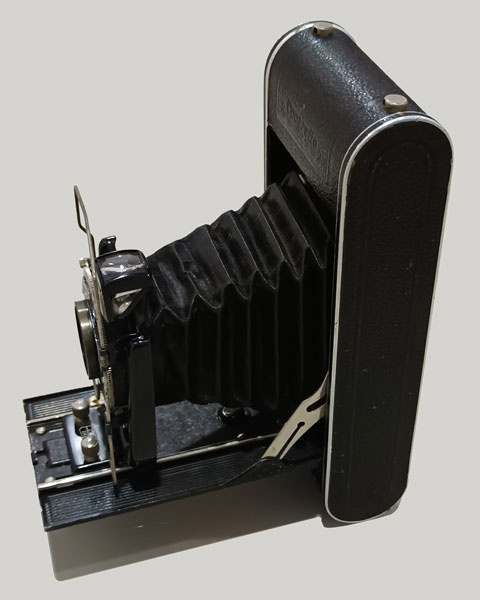 The left side of the camera body (standing upright) is smooth and has no buttons. I like this part the most.
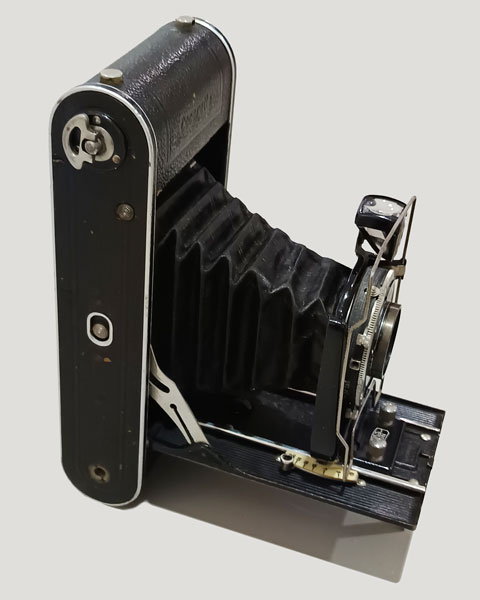
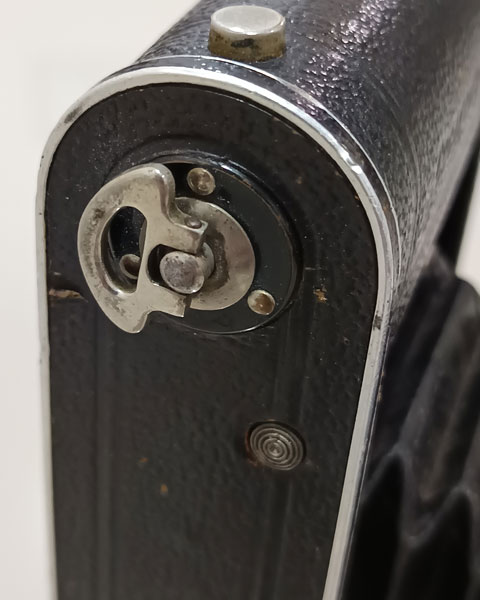
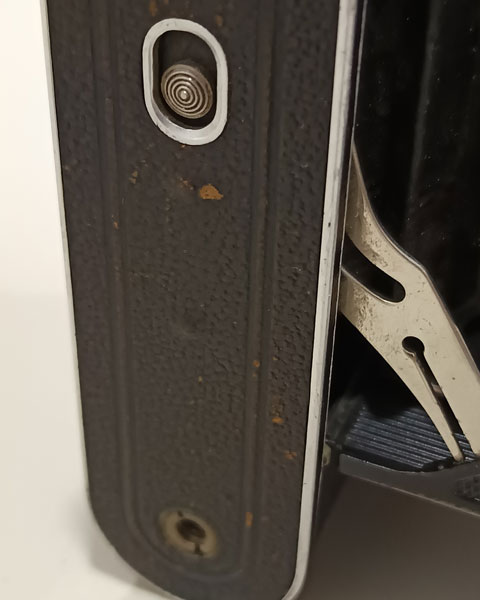
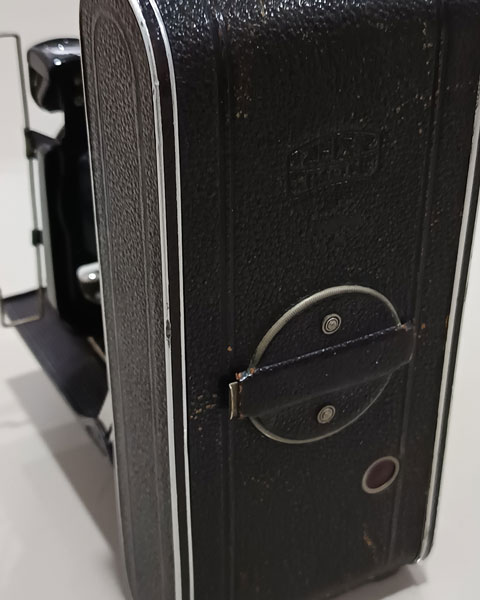
On the right side of the camera (standing) are the film winder, the front cover release button, the film loading lock button, and the screw holes for the tripod plate, in order from top to bottom.
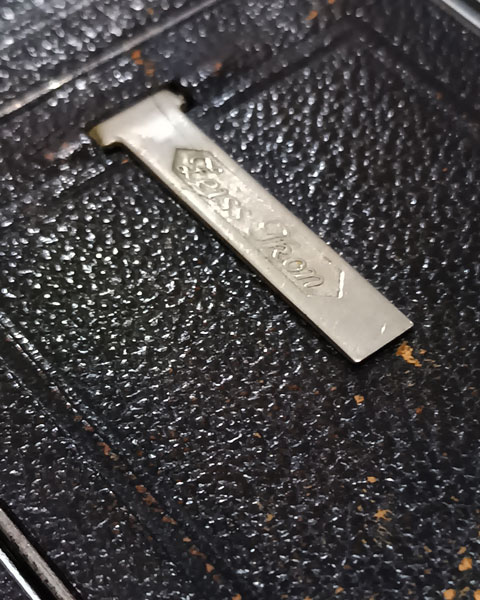
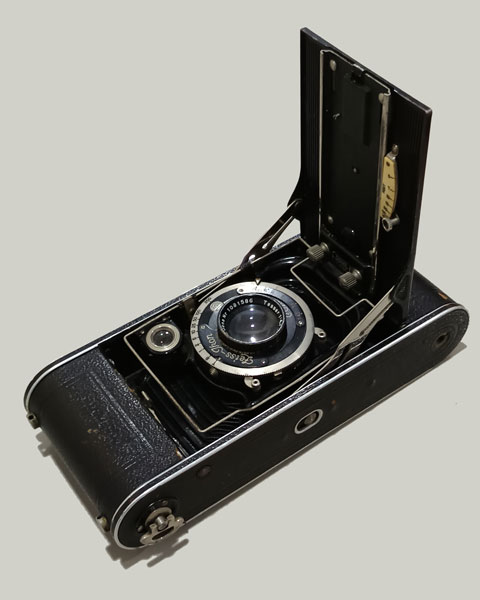
On the front of the camera cover, there is a folding metal for setting the camera when it is unfolded.
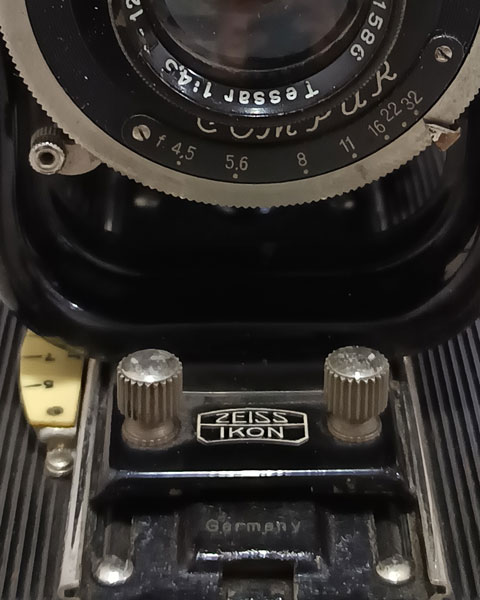
Press the button to open the front cover on the side. The cover will open. And pull the two buttons on the front to pull the lens out along the rail until it reaches the stop of the rail.
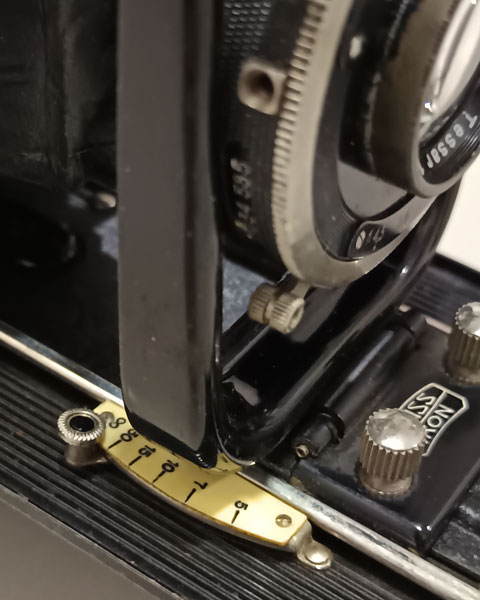
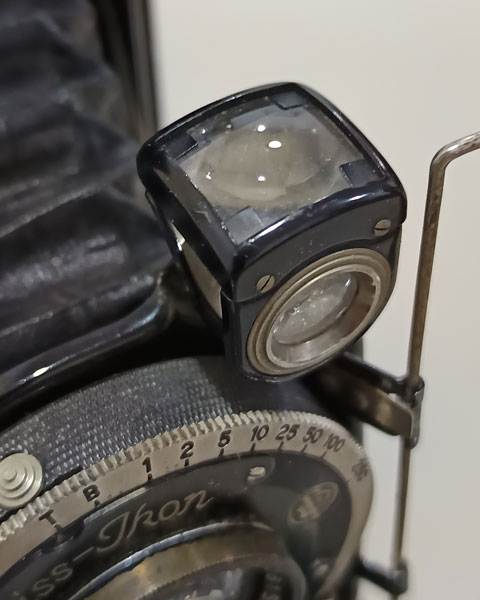
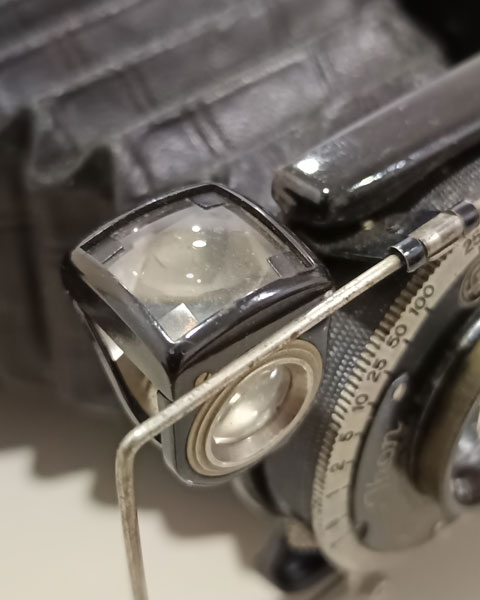
When the lens is pulled out to the end of the rail, on the side of the rail, there will be a focus slide button, the distance according to the number indicated. On top of the lens, there will be a Brilliant Viewfinder that can be rotated, so you can view both vertically and horizontally.
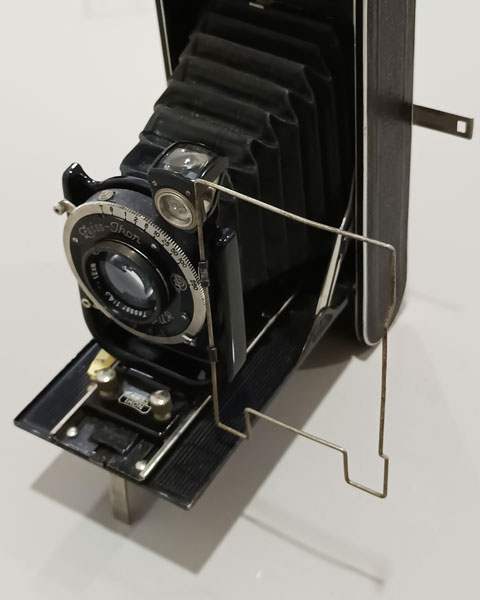
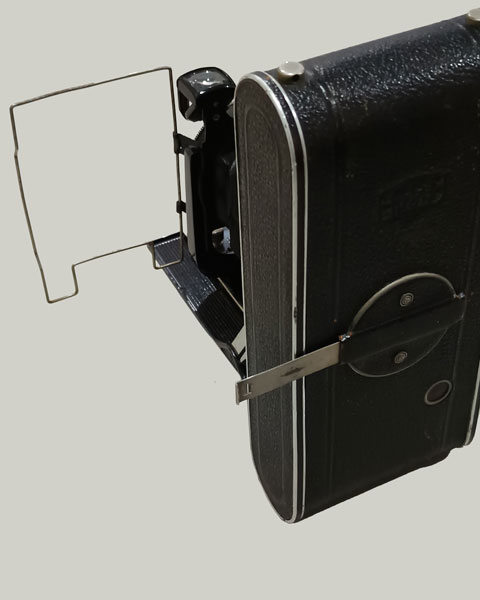
In front of the lens, there is a rectangular wire frame that can be folded.
When unfolded, it becomes a window for aiming the image.
On the back of the camera, there is a metal plate that can be pulled out.
Pull it all the way out to the axis. To be a rear viewfinder, related to the front wire frame.
The original Contessa-Nettel camera design attempted to make loading film easy, with an optional plate that pulled out to load film and slid it back into the camera. Since there was no removable back cover, there was a circular door on the back of the camera that could be rotated open, allowing access to the rear lens for cleaning or lens removal.
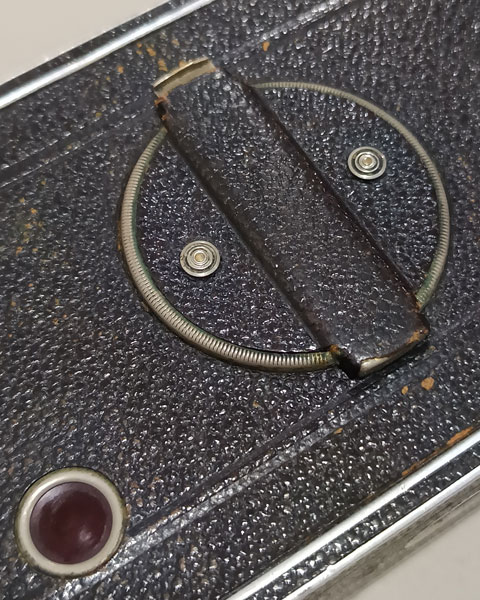
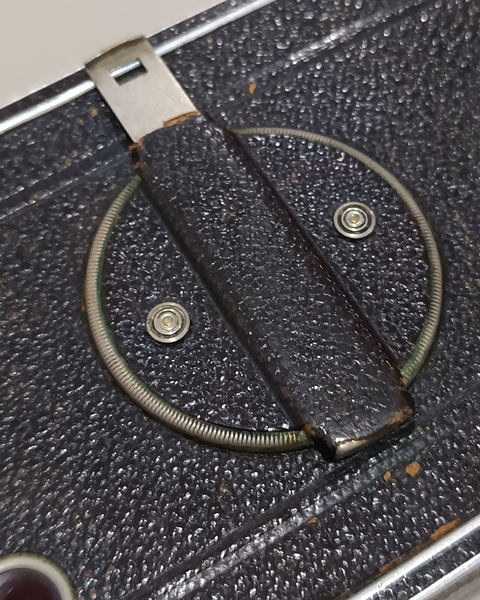
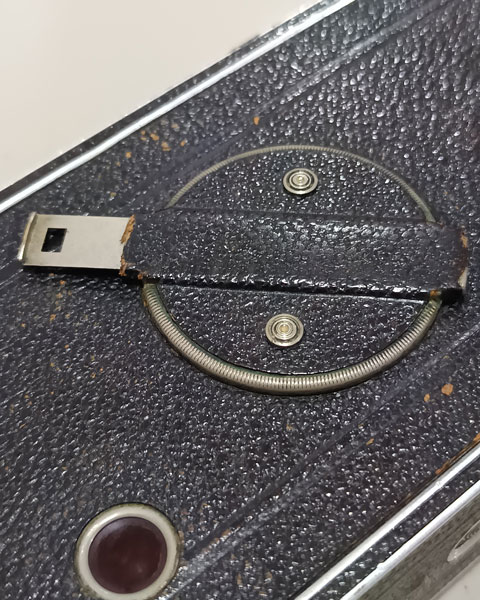
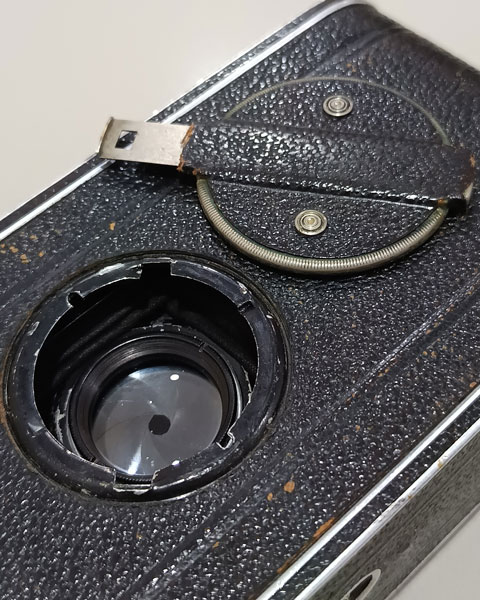
Since the back does not have a back cover that opens like a typical film camera,
an opening must be created to allow the rear lens to be removed or cleaned.
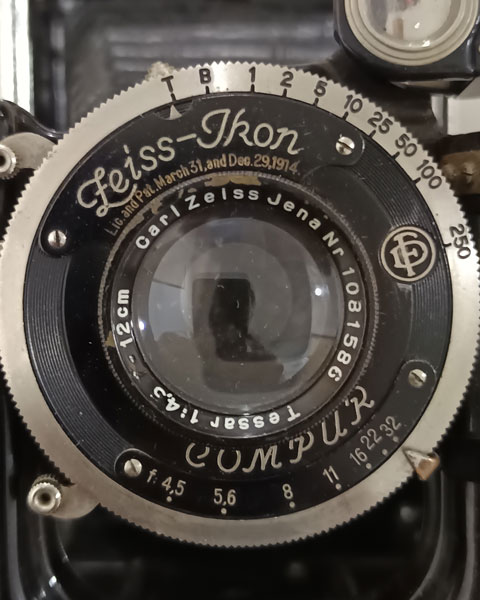
The lens of this camera is CarlZeiss Jana Tessar 1:4.5 12cm.
The front shows the aperture and shutter speed, which can be adjusted from the lens.
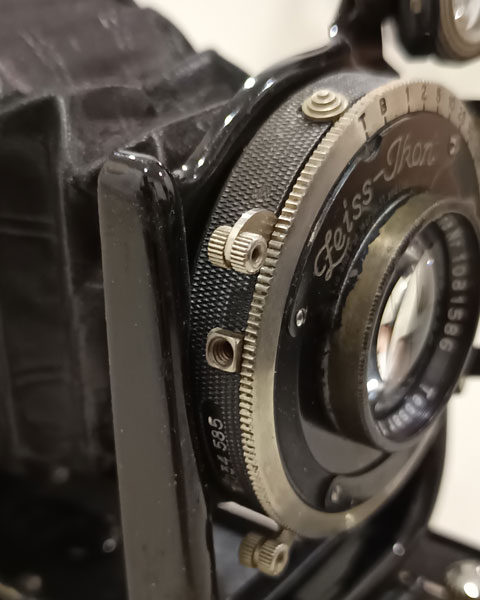
On the right side of the lens, at the top is the shutter release,
below is the shutter release thread slot, and at the bottom is the shutter.
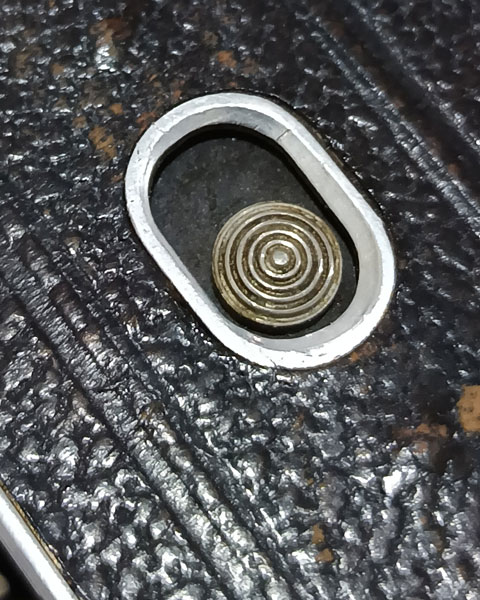
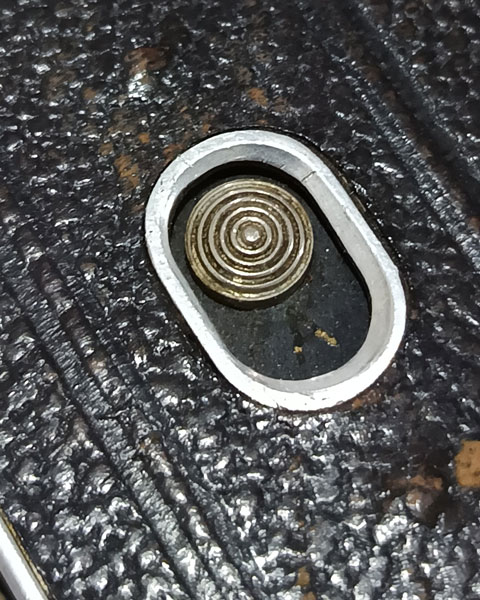
The button to open the film roll holder. If it is locked normally, it is a Z.
Slide it the other way to see an A and then it can be removed.
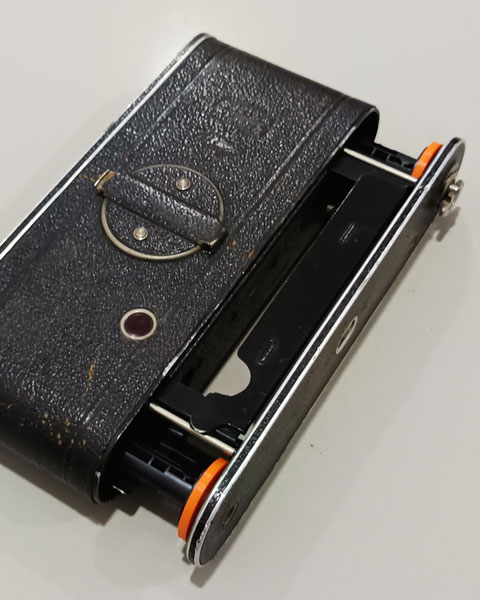
Pull out and remove the film holder to load film.
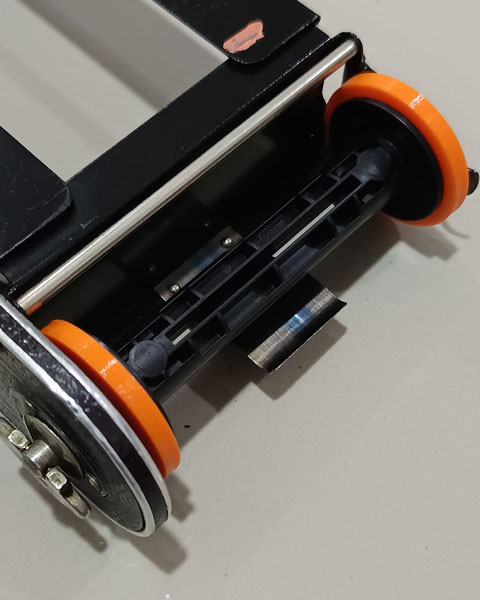
What you see in the picture is a 120 film roll spool (black) using an add-on (orange) from 116 film to convert it to use 120.
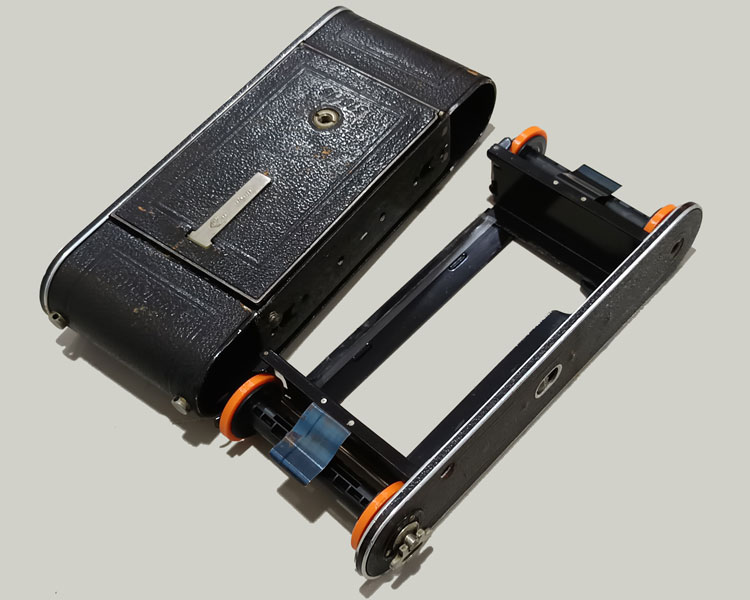
When the film is loaded, put it back in its original place and lock it so that it does not slide out. Get ready to take pictures.
It is estimated that this camera model was discontinued around 1930.
Note from the catalog of Zeiss Ikon in 1931 that this series of cameras is no longer available.
The specifications of the Zeiss Ikon Cocarette shown here
Zeiss Ikon Cocarette 519/15
Made in Germany
Film size: 116 rollfilm
Frame size: 6.5x11cm
Lens: Tessar 1:4.5 f12cm
Shutter: Compur
Sample photo form this Zeiss Ikon Cocarette 519/15
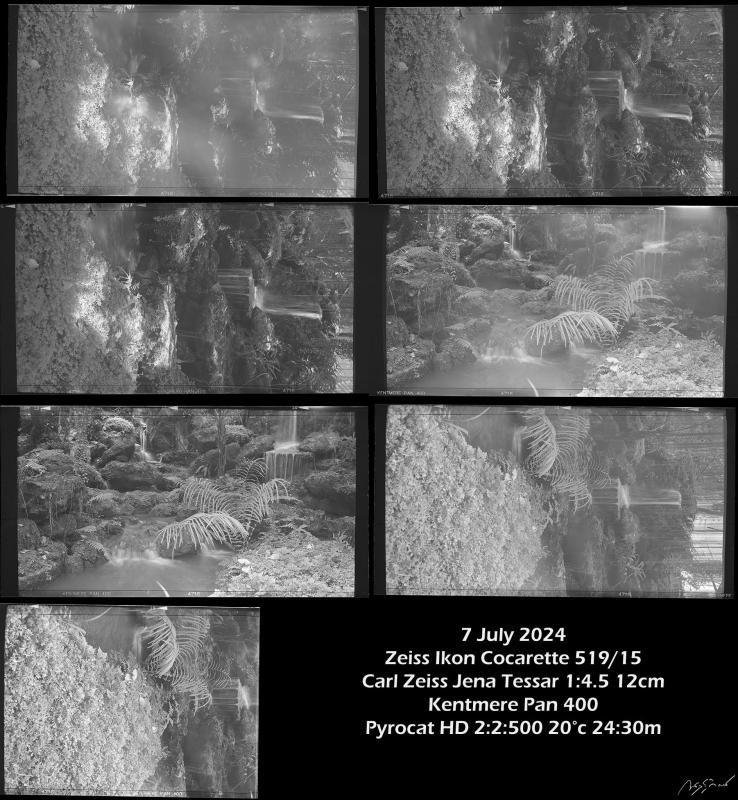 Zeiss Ikon Cocarette 519 15 Photo Digital Contact Sheet
7 July 2024
Zeiss Ikon Cocarette 519/15
Carl Zeiss Jena Tessar 1:4.5 f12cm
Kentmere Pan 400 120
Pyrocat HD 2:2:500 20c 24:30m
Epson V600 : Photoshop
Since the back of the camera has a transparent red circle to indicate the shooting sequence, however, the film used is 120 film, which is smaller than 116 film, so light leaks into the film as seen in the sample image. This is because the camera takes a long time to take each photo, so light leaks into the film. To get better results, you should put black tape over the light, which will help block light from entering the film.
Full film format, approximate film size 60 x 11 cm.
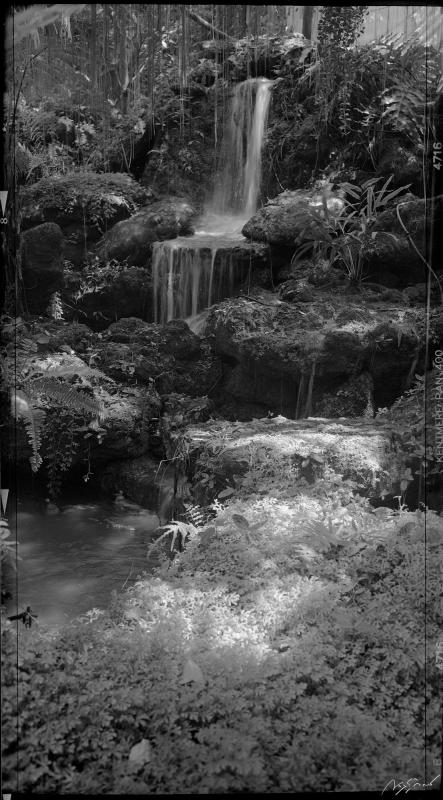 Zeiss Ikon Cocarette 519/15 Sample Photo 003
Zeiss Ikon Cocarette 519/15 Sample Photo 005
Zeiss Ikon Cocarette 519/15 & The "Eagle Eye" Tessar
Now that we've covered the specs and design, let's look at the real-world performance of this century-old folding camera, equipped with the Carl Zeiss Jena Tessar $1:4.5$ $12\text{ cm}$ lens and a classic Compur shutter.
Test Setup
-
Camera: Zeiss Ikon Cocarette 519/15 (1920s)
-
Lens: Carl Zeiss Jena Tessar 1:4.5 12 cm (Serial No.1081586$)
-
Shutter: Compur
-
Film: Kentmere Pan 400 (Black & White 120 Film)
-
Location: Tropical Botanical Garden featuring artificial waterfalls and lush foliage.
Shooting Experience & Composition
The test setting presented a challenging high-contrast environment—direct overhead sunlight mixed with deep, heavy shadows under the canopy. Kentmere Pan 400 provided the necessary latitude to retain detail in both bright highlights and deep shadow zones.
-
Vertical Frames: Using the rotating Brilliant Finder set to portrait orientation, framing the full height of the waterfall alongside the foreground foliage was intuitive and precise.
-
Horizontal Frames: By utilizing a tripod and setting the camera in landscape mode, expansive compositions capturing the full width of the stream and rock formations were rendered effortlessly.
Highlights: Ambience & Depth of Field
The Tessar f/4.5 excelled at creating smooth, silky motion blur across the running water. By using slower shutter speeds mounted on a stable base, the flowing water renders with soft, elegant streaks. Closing down the aperture slightly (f/4.5 – f/8) provided a natural layer separation between the foreground ferns, the midground stream, and the background waterfall, giving the image exceptional three-dimensional depth.
Image Analysis
| Vertical Frame | Horizontal Frame |
| Focus Point: Razor-sharp on the central foreground foliage/moss. | Focus Point: Exceptional detail across the large fern leaves to the right of the stream. |
| Details: Great shadow recovery on the dark rock textures without sacrificing overall contrast. | Dimensionality: Excellent use of the stream as a leading line guiding the eye toward the upper fall. |
Conclusion: Performance Verdict
These test frames prove that a well-maintained Carl Zeiss Jena Tessar 1:4.5 12 cm remains an optical marvel even after nearly 100 years. It delivers high center sharpness, superb tonal gradation, and a distinct organic rendition that modern lenses simply cannot replicate.
The Zeiss Ikon Cocarette 519/15 is not just a piece of history—it remains a fully capable, highly rewarding creative tool for vintage film photography.
Behind the Scenes: Processing Data
The contact sheet includes precise processing documentation for reference:
-
Date: July 7, 2024
-
Equipment: Zeiss Ikon Cocarette 519/15 / Carl Zeiss Jena Tessar 1:4.5 12 cm
-
Film: Kentmere Pan 400
-
Developer / Chemistry: Pyrocat HD 2:2:500, 20°C for 24:30 mins


Comments powered by CComment