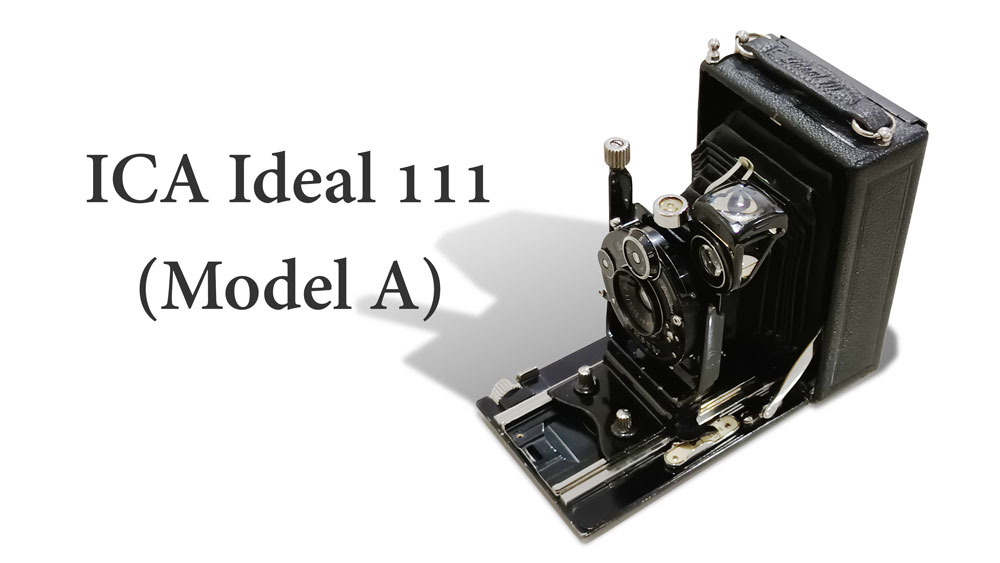
Ica Ideal 111 – Classic German Folding Plate Camera
The Ica Ideal 111 is a premium early 20th-century folding plate camera manufactured by the renowned Ica A.G. (Dresden, Germany)—a company that later merged to become a key part of the legendary Zeiss Ikon. Known for its exquisite craftsmanship, robust build, and versatile functionality, this model was a favorite among professional photographers of its era.
Technical Specifications
-
Brand / Manufacturer: Ica A.G., Dresden (Germany)
-
Model: Ideal 111
-
Lens: Ica "Novar-Anastigmat" 1:6.8 f=9cm (Serial No. 550377)
-
Shutter: COMPUR (D.R.P. No 258646 / D.R.G.M.)
-
Shutter Speed: 1 sec to 1/250 sec, plus B (Bulb), Z (Zeit/Time), and M modes
-
Viewfinder: Swiveling Brilliant/Reflex Finder with an integrated bubble level
-
Focusing System: Double extension bellows with precision rack-and-pinion thumbwheel adjustment
-
Media / Format: 6.5x9 cm Glass Plates or cut film via single sheet metal plate holders
Key Features & Highlights
-
Double Extension Bellows: The bellows extend to twice their standard length, allowing for extreme close-up (macro) photography and compatibility with longer focal length lenses.
-
Rise & Fall / Cross Movements: The lens standard offers vertical and horizontal shift adjustments to control perspective distortion—ideal for architectural photography.
-
Exceptional Craftsmanship: Built with a durable aluminum body wrapped in fine black leather, offering a sturdy yet relatively lightweight design for its time.
Product Description / Website Copy
"Experience the Pinnacle of 1910s–1920s German Craftsmanship with the Ica Ideal 111"
If you are looking for a legendary vintage camera steeped in history and mechanical precision, the Ica Ideal 111 is a collector's masterpiece. Hailing from Dresden, Germany, this folding plate camera features the sharp Ica Novar-Anastigmat 90mm f/6.8 lens paired with a reliable Compur shutter.
Featuring a double-extension leather bellows and full lens-shift perspective control, it represents the cutting-edge photographic innovation of its era. An ideal addition for antique camera collectors, studio decor, or history enthusiasts passionate about classic plate photography.
The ICA Ideal camera was manufactured or assembled in Dresden, Germany from (approximately) 1910 to 1926, the last year it was called ICA as it was merged with other holdings under the name Zeiss Ikon.
ICA Ideal Model "111" or another name is "Model A" is a small folding camera using 6.5x9 cm plate and 2 1/4 x 3 1/4 inch film pack. It is a camera that is in the era of transition from dry plate coated glass to clear plastic film coated with a photosensitive substance, both in sheet film pack and 120 film rolls that are still in use today. There are many types of lenses. Looking at the camera, it was originally designed to be used with dry plate glass and plastic film, called Sheet Film Pack. I tried to find additional equipment that allows it to be used with roll film, called Roll Film, so this camera can be used with many types of film. ...
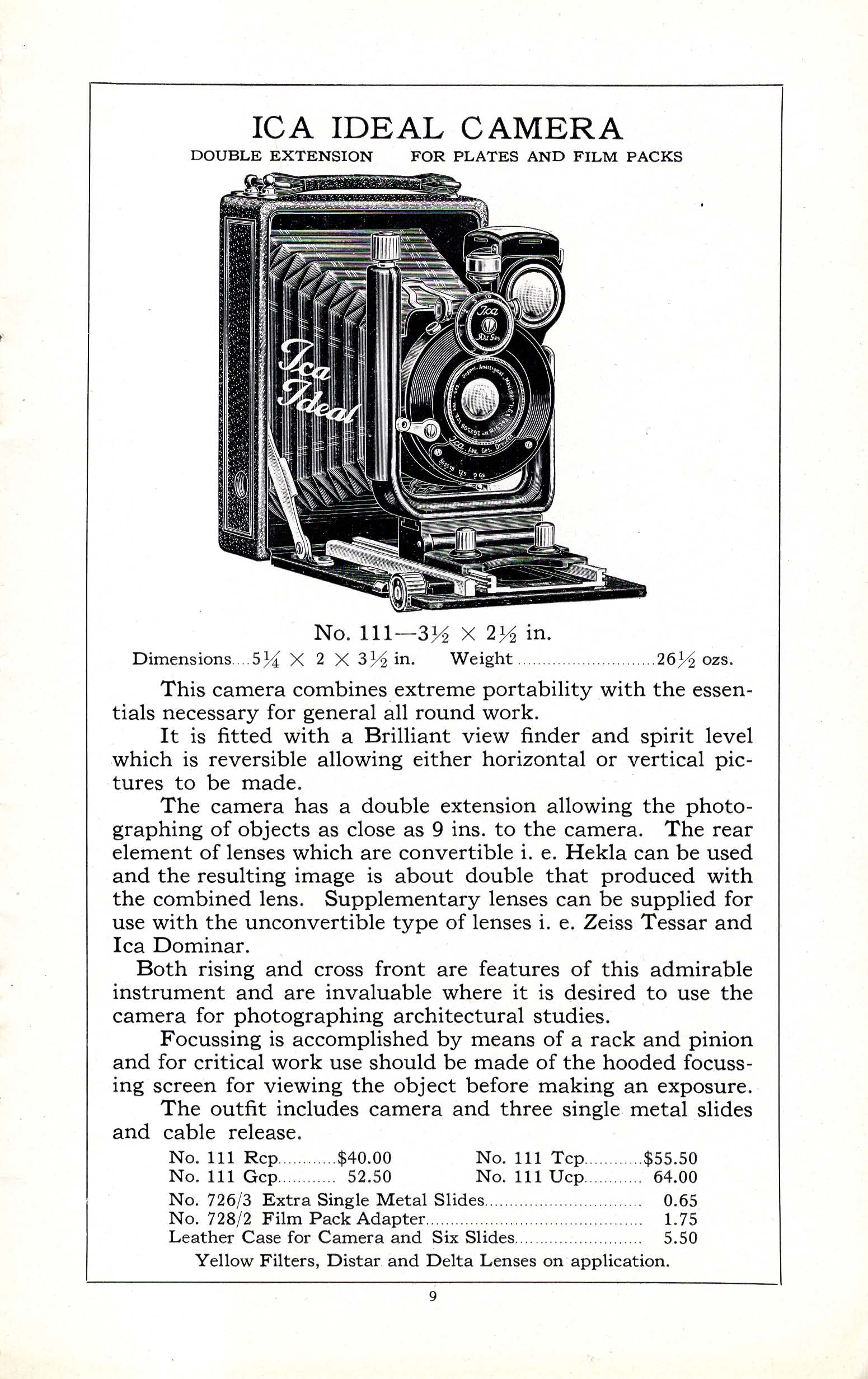 Details and prices of the ICA catalogue at that time, around 1925.
The ICA Ideal 111 is considered a high quality camera, both in terms of its many adjustable functions and the quality of the lens at that time. The ICA catalog has pictures and details of the camera. The price, looking at the cheapest model, is $40. If you compare the price from 1925 to the present (2024), you will get about $721 , which is 25,000 baht, a little less.
Let's take a look at the details of this camera. What were the high-priced cameras of that era and how were they used?

The ICA Ideal 111 is a foldable camera, making it compact and portable.


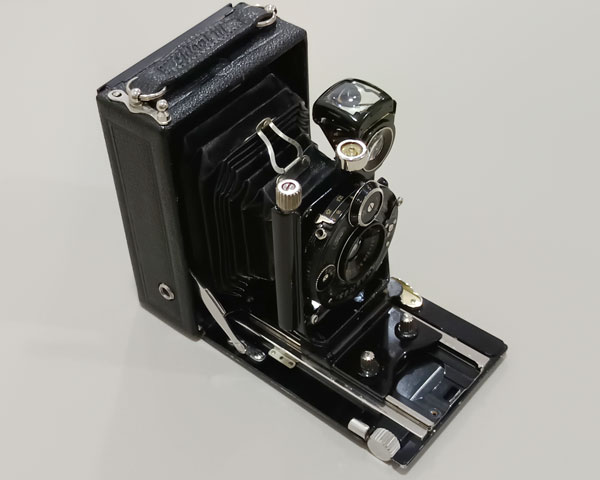
Pressing the button on the top of the camera opens the front cover, revealing the lens assembly and the lens ejection rail.
Grasp the two buttons on the front of the lens, squeeze and pull the lens out as far as it will go, and the camera is ready to use.
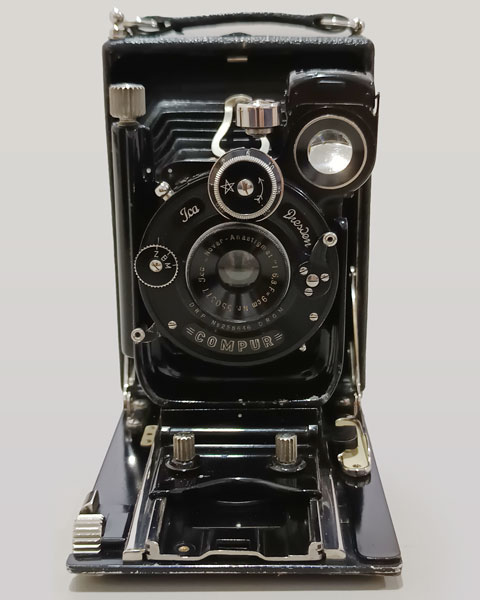
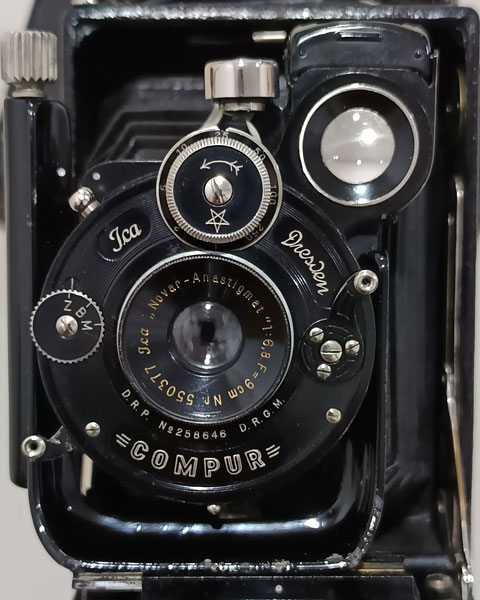
The front of the camera when unfolded and the details of this lens.
When unfolded, the front of the camera consists of the lens set, the lens up-down dial, the viewfinder, the spirit level.
On the slide rail, if you turn the camera away from you, there will be a focus adjustment button on the right, the lens slide rail in the middle, and the focus distance scale on the left.
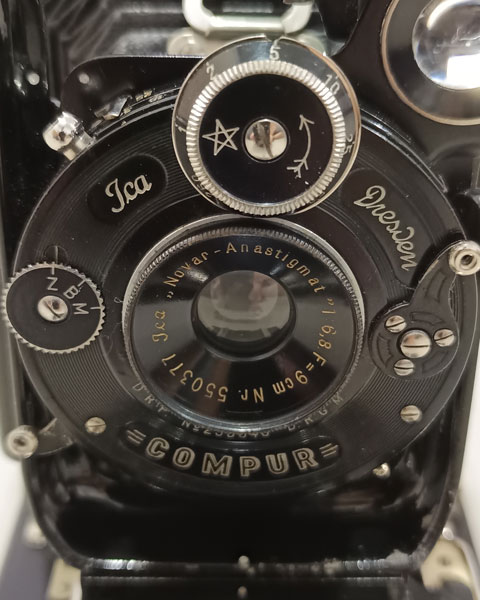
Details of this lens.
Normally, a camera of this size will see that it is an F=10.5cm lens, but this one is F=9cm, giving a wider angle of view.
It is an Ica "Novar-Anastigmat" 1:6.8 F=9cm COMPUR shutter lens.
Clockwise, at the top, at 12 o'clock, there is a round dial for adjusting the shutter speed.
At 3 o'clock, there is a shutter trigger, which is not needed when using Z (Time) and B (Blub).
At 4 o'clock, there is a small round silver button on the edge of the lens for adjusting the aperture value (f).
At 8 o'clock, there is a shutter release.
At 9 o'clock, there is a round dial for changing shutter modes, Z (Time), B (Blub), and M, which release the shutter at the set time.
And at around 10 o'clock, there is a slot for the shutter release cable.
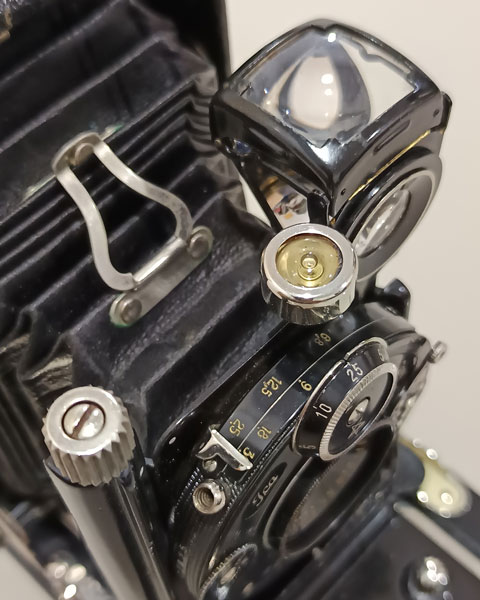
On the top of the lens, you will see the numbers showing the shutter speed on the dial and the aperture value on the side of the lens.On the right side of the lens is the high-low adjustment button of the lens. On the left side is the viewfinder, which can be rotated vertically, horizontally, and with a spirit level.

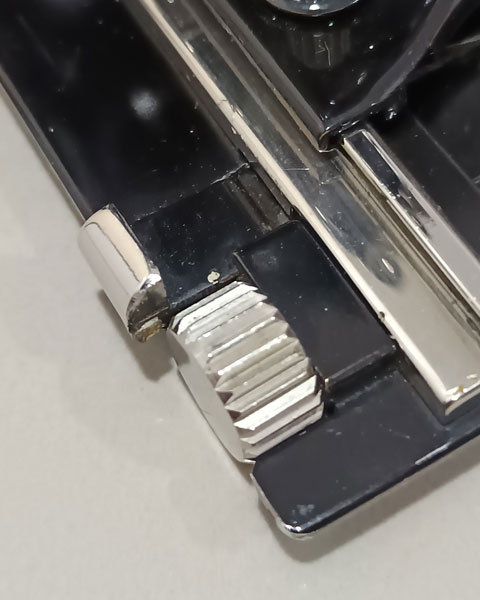
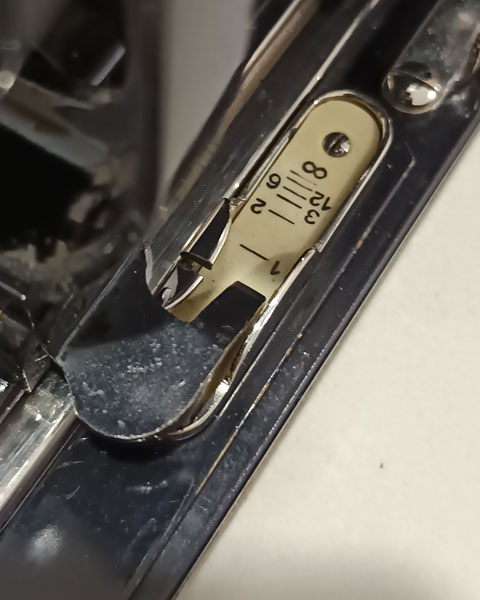
On the left rail, there is a lens lock and a focus distance dial. When pulled all the way, the lens will be locked. You must first pull out the latch behind the focus dial before you can turn it for focus distance. This camera tells the distance in meters.


On the top of the bello, there is a lock when in normal use. Release the lock and slide the rail out. It will extend the bello by 2 times, allowing you to take close-up or macro 1:1 photos as close as 9 inches to the object.


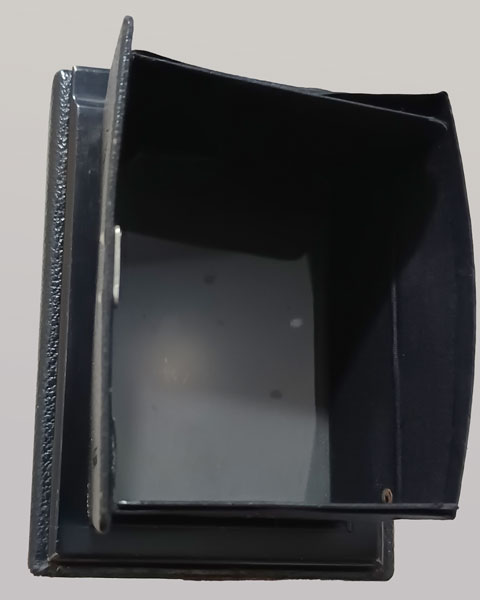
The right side of the camera is simple with a tripod thread slot. The left side is plain. The back side has a hood and a Ground Glass for viewing and focusing.


Brilliant Viewfinder Rotating viewfinder that can be adjusted vertically and horizontally with a spirit level.
The lens height adjustment dial is up and down


The lens can be adjusted up and down (Rise and Fall).


อีกทั้งยังสามารถปรับ เลื่อน ซ้าย-ขวา ได้ (Shift)


On the top of the camera, on the right hand side, there is a button to release the back panel to change the film holder. In the picture, it is a holder for the glass film that comes with the camera.


This ICA Ideal 111 camera at that time was produced to use with glass film and sheet film,
Pack Film type, as shown in the picture on the left.
On the right, I have a holder for 120 roll film. I tried to apply it and tested it. It works well, but you have to be careful when using it.
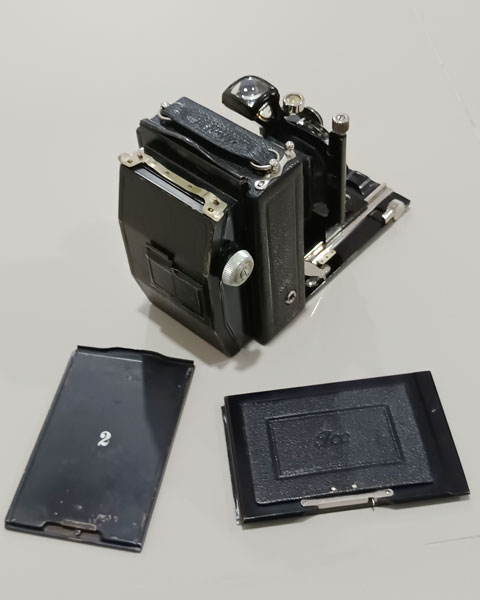
Currently in use, Pack Film in sheet form is no longer available, so it is not possible to try shooting.
Ready-to-use set, a holder for Dry Plate glass film, which is still being sold today.
And the holder for 120 roll film, which is still in use today, is now ready to go out and take pictures.
Sample photo from ICA Idel 111 (Model A)
 No.001
ICA Ideal 111 : Novar-Anastimat 9cm f6.8
J. Lane Dry Plate 6.5x9cm ASA2
f25 : 30 min.
HC-110 Dilution B : 5mins
The Main Door of the Phra Ubosot, Wat Ratchabophit
-
Description: A detailed shot highlighting the exquisite craftsmanship of the Phra Ubosot's main entrance, flanked by bronze elephant statues on marble pedestals. The rich black-and-white tonal range produced by the dry plate process beautifully emphasizes the intricate textures and architectural depth, exuding a timeless and historic quality unique to Wat Ratchabophit Sathit Maha Simaram.
 120 Roll film Black and White
Mother-of-Pearl Inlay Door & Bronze Elephants (Wat Ratchabophit)
-
Description: A detailed shot emphasizing the exquisite mother-of-pearl inlay on the main temple doors, flanked by bronze elephant statues resting on marble pedestals. The 120 black-and-white film beautifully highlights the textures of the inlay and metalwork, evoking a serene, solemn, and historic ambience.
The two photos above were taken in the same position, with both dry plate glass film and black and white 120 roll film.
Let's compare them. This photo was taken in the shade, with no sunlight.
The exposure time was 15 minutes, because ISO2 dry plate needs to be doubled if it exceeds 2 minutes.
Luckily, no one was walking by during those 30 minutes, the light did not change much, and there was no sun at all.
 No.002
ICA Ideal 111 : Novar-Anastimat 9cm f6.5
J. Lane Dry Plate 6.5x9cm ASA2
f25 : 40 Sec.
HC-110 Dilution B : 5mins
The Facade and Entrance of the Phra Ubosot
-
Description: A wide architectural view showcasing the stunning facade of the Phra Ubosot at Wat Ratchabophit Sathit Maha Simaram. The image captures the graceful lines of the crown-shaped spires, the ornate archways, and the polished marble steps. Using an authentic early 20th-century photographic process renders the architectural proportions with impressive sharpness, resembling an authentic archival photograph from a bygone era.
 120 Roll film Black and White
Archways and Crown Spire Architecture (Wat Ratchabophit)
-
Description: A wide perspective showcasing the ornamental pediment and crown-shaped spires of the Phra Ubosot at Wat Ratchabophit. Using the century-old Ica Ideal 111 renders the architectural proportions with authentic historic flavor while maintaining the impressive sharpness and depth inherent to Medium Format photography.
Glass film can only absorb ultraviolet light. Note the Buddha image inside. Dry Plate glass film will not show it at all.

Iconic Majesty via Medium Format (Wat Ratchabophit)
-
Description: A striking architectural view of Wat Ratchabophit, capturing the graceful lines of Thai temple design. The smooth, rich black-and-white tonal range and gentle contrast—characteristic of the vintage Ica Novar-Anastigmat lens paired with Medium Format film—give the image remarkable depth and life.
The ability to Rise the lens by moving the lens up helps to take beautiful, straight architectural photos.This photo is a full-film photo, not cut, cropped, or adjusted Perspective.
Shooting Data Sheet
-
Camera: Ica Ideal 111 (c. 1910s–1920s)
-
Lens: Ica "Novar-Anastigmat" 1:6.8 f=9cm (Century-Old Optics)
-
Film: 120 Black & White Film (Medium Format)
-
Accessories: 120 Roll Film Back Adapter
The Aesthetic Charm: Century-Old Novar Optics on 120 Film
Pairing an early 20th-century folding plate camera with 120 medium format roll film offers a uniquely rewarding photographic experience:
-
Vintage Tonal Quality: Uncoated vintage lenses like the Novar-Anastigmat render soft, subtle black-and-white contrast rather than the harsh, punchy look of modern optics. This allows for rich shadow details and smooth highlight transitions that film enthusiasts cherish.
-
Authentic Lens Character: Vintage optical designs provide a classic signature—gentle edge softness and unique depth—that stands out distinctly from crisp digital images.
-
Medium Format Detail: The larger negative area of medium format film yields significantly higher resolution and smoother tonal gradations compared to standard 35mm film, bringing out the finer details of complex architecture.


Comments powered by CComment